Hirotake Yamazoe
Associate Professor | Ph.D. in Engineering
Artificial Intelligence and Informatics Course
Visual Media Engineering Research Group
In his courses on image processing and microcontroller-based robot programming, Associate Professor Yamazoe pairs each technique with working sample code, encouraging students to build a hands-on, implementation-level understanding of the methods they study.
Computers That Understand Human Intention and Attention
What students can learn
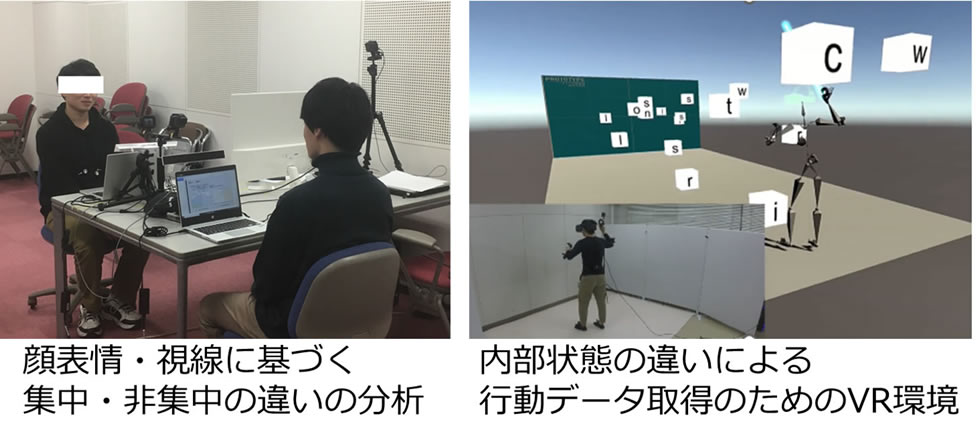
In this line of work, students become familiar with the devices and techniques used to capture human behavior—such as recording facial expressions with cameras—and gain hands-on experience in VR programming, since virtual environments are often used to construct controlled scenarios for behavioral measurement.
For computers and robots to respond appropriately to people, they must first infer internal states such as interest, emotion, and intention. Because these states are reflected in facial expressions, gaze, posture, and other behavioral cues, this research focuses on the subtle behavioral variations they produce in order to estimate a person's underlying state.
Robots That Interact Intelligently with People
What students can learn
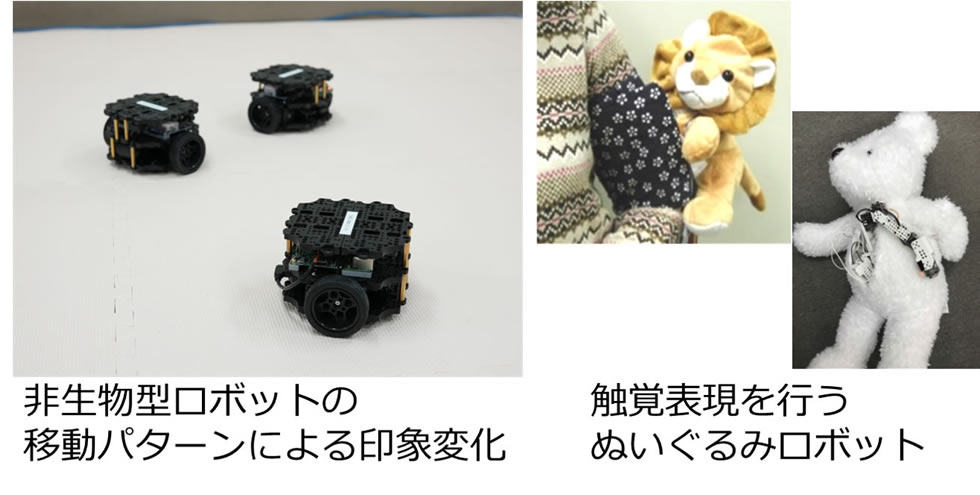
Students gain practical experience in robot programming and in building robots with microcontrollers, sensors, and 3D printers, along with methods for evaluating how people perceive and respond to robots.
This research explores robots capable of inferring a person's interests and intentions and adapting their behavior or communication accordingly. Examples include an interactive signage system in which a plush robot guides visitors based on interest inferred from gaze direction, expressive strategies for non-biological robots such as cleaning robots, and plush robots designed to communicate through tactile expression.