Keita Morimoto
Associate Professor | Ph.D. in Engineering
Artificial Intelligence and Informatics Course
Optics and Wave Engineering Research Group
Keita Morimoto investigates optical communication technologies that underpin the information networks central to modern life. In his laboratory, mathematical and physical principles introduced in coursework become practical tools for creating new value, giving students a solid foundation on which to build their own research ideas.
Electromagnetic Simulation Technologies for Optical Waveguides
What students can learn
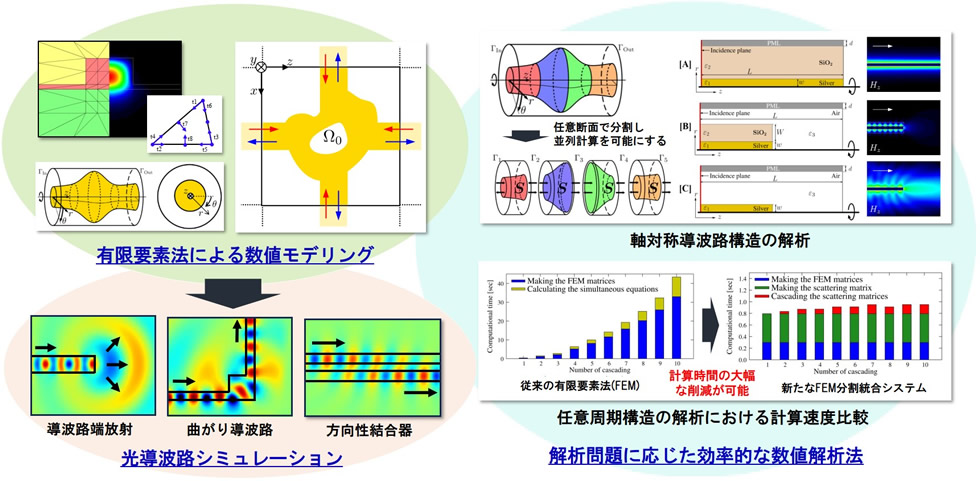
In this theme, students gain hands-on experience with numerical analysis methods that make invisible electromagnetic fields visible, along with the large-scale computation techniques and programming skills needed to put them into practice.
This research develops efficient numerical simulation software that is essential to the design of new optical devices. Building on methods such as the finite element method, it refines the numerical treatment of optical waveguides through element modeling, boundary conditions, and matrix operations, with the aim of establishing a robust platform for large-scale electromagnetic field analysis.
Design of High-Performance Electromagnetic Wave Devices
What students can learn
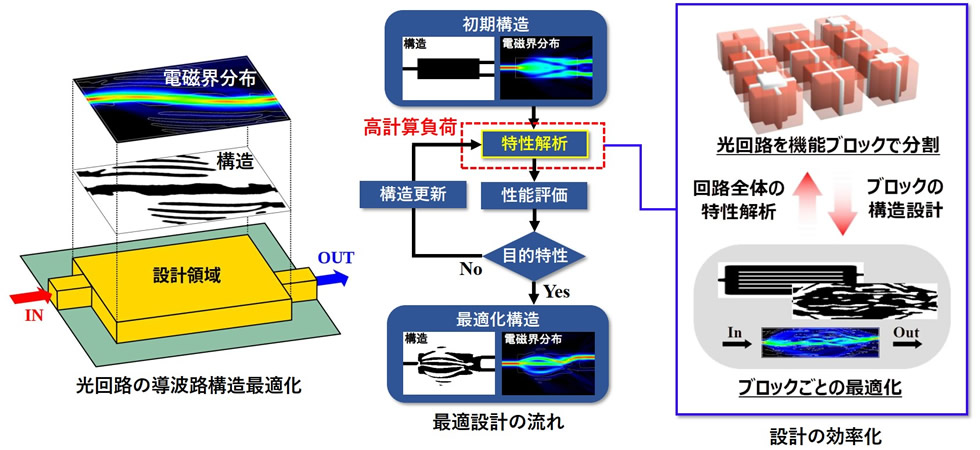
Students develop expertise in optical signal processing and optical circuit design, together with broadly applicable structural design methods based on optimization algorithms.
This research aims to create new control devices that exploit the distinctive propagation properties of electromagnetic waves. By applying optimization algorithms to electromagnetic waves whose behavior varies with the surrounding materials and structures, the work explores novel optical and electromagnetic devices that could contribute to smaller, lower-loss, and more cost-effective components for next-generation optical communications, with potential future applications in the terahertz band.