Naotake Kamiura
Professor | Ph.D. in Engineering
Artificial Intelligence and Informatics Course
Intelligent Mathematical and Computational Sciences Research Group
In his lectures, Professor Kamiura traces each mathematical formula back to its underlying rationale, helping students grasp not only how a method works but why it takes the form it does. His research is fundamentally collaborative, built on close, ongoing discussions with physicians in ophthalmology and pathology. Through this work, students learn to frame precise questions for medical specialists and to translate the resulting insights into their own research.
AI Applications in Pathology
What students can learn
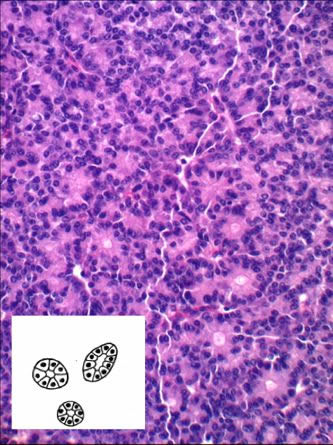
Students gain a working knowledge of pathology, including the biology of malignant neoplasms such as cancers and tumors, alongside practical programming skills in deep learning.
This research applies AI techniques to model how cancer develops and progresses. Despite advances in medical technology, much about the underlying dynamics of tumor growth remains poorly understood. By representing the proliferation of cancer cells through mathematical models, the project examines the mechanisms driving this growth, with the aim of eventually supporting computer-based simulations that could help evaluate the efficacy of candidate treatments.
AI Support for Ophthalmic Treatment
What students can learn
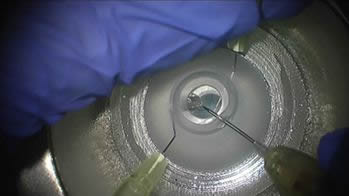
Students become familiar with the precision instrumentation used in ophthalmic examination systems, while developing programming skills in deep learning.
This project develops AI-based systems to support ophthalmic surgery. As part of a training system for intrascleral intraocular lens fixation, the research applies deep learning to track surgical instruments in real time. Work to date has used recorded surgical footage, with the aim of progressing toward real-time tracking using video captured during procedures performed on model eyes.