Takanori Hashimoto
Assistant Professor | Ph.D. in Engineering
Department of Engineering, Artificial Intelligence and Informatics Course
Artificial Intelligence and Informatics Field, Intelligent Mathematical and Computational Science Research Group
My teaching focuses primarily on programming. Because students spend relatively little time studying information science in elementary, junior high, and high school, their levels of understanding vary widely. I therefore strive to ensure that students who encounter difficulties are not left behind while also meeting the needs of those who wish to study the subject in greater depth.
In research, I want students not only to program but also to gain experience building things with their own hands. Precisely because generative AI can now write code, I hope students will acquire the ability to turn ideas into reality and connect hardware and software to make them work together.
Intelligent Control of Robots that Adapt to Their Environment
What students can learn
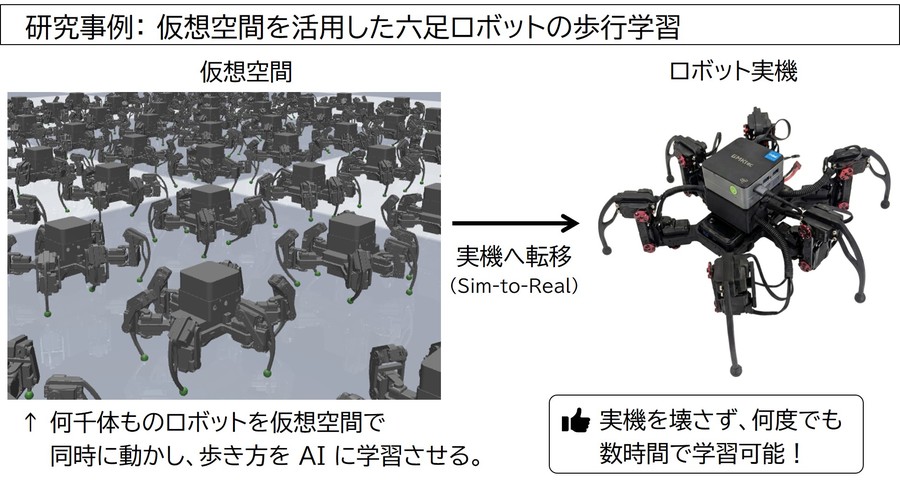
Students can learn AI training methods, including reinforcement learning, how to use physics simulations, and techniques for deploying trained AI on physical robots.
We study intelligent control that enables robots to act adaptively in response to their environment using reinforcement learning, Model Predictive Control, Mathematical Optimization, and other methods. Our main focus is locomotion control for hexapod robots, including Sim-to-Real techniques for transferring controllers trained in simulation to physical robots. We aim to realize flexible, intelligent robots that can select appropriate actions autonomously according to the situation.
Robot Environment Understanding and Action Generation Using Foundation Models
What students can learn
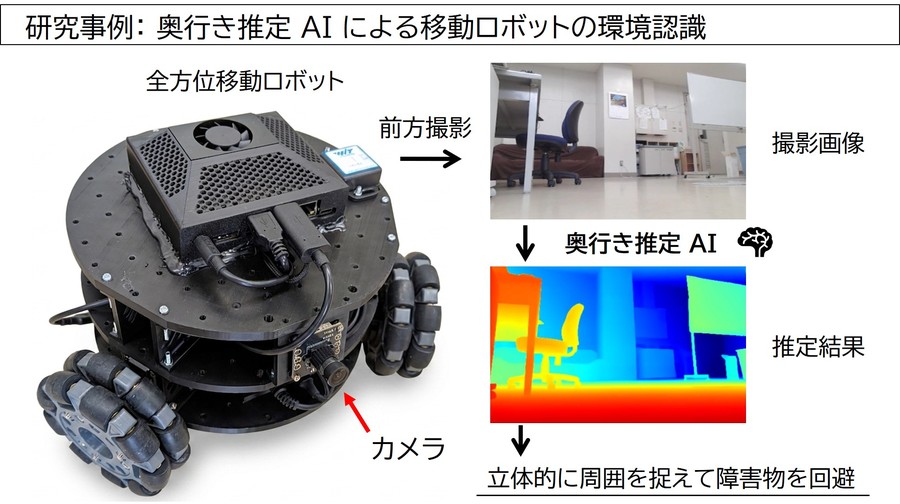
Students can learn how AI foundation models that process images, language, and depth information work and how to use them, as well as techniques for running large-scale AI models efficiently on edge devices.
To realize robots that can understand images and language and act in accordance with human instructions, we study environment understanding and action generation using foundation models. We also work on implementation and optimization techniques for running the latest AI models on small computers and integrating them into physical robots. By combining AI and robotics, we aim to realize intelligent robots that operate in the real world.