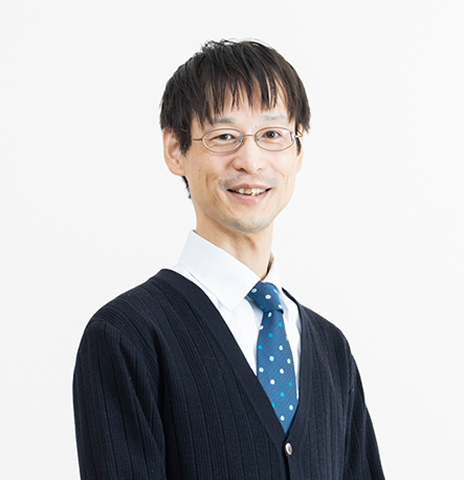
Yasushi Hotta
Professor | Ph.D. in Science
Electrical and Electronic Engineering Course
Structural Properties Research Group
Rather than presenting electrical engineering as a fixed catalog of formulas, Yasushi Hotta traces how its core concepts came to be, from transient responses in electric circuits to the fundamentals of semiconductor devices, so that students grasp not only how these ideas work but why they emerged. His research follows two distinct threads: control systems inspired by biological principles, and electronic devices that combine transition-metal oxides with silicon.
Development of Control Systems Inspired by Biological Principles

What students can learn
In hands-on projects such as building robots that imitate biological muscles, students learn to design components with 3D CAD software and fabricate them using 3D printers.
This research investigates the control principles that allow robots and machines to operate flexibly, robustly, and with minimal energy consumption. The group builds hardware that imitates biological organs such as muscles, then draws on patterns of animal movement to learn how to operate it. The aim is to uncover the underlying control principles at work in living organisms and to confirm that systems built on these principles are energy efficient, adaptable, robust, and capable of autonomous operation.
Unconventional Electronic Devices Combining Metal Oxides and Silicon

What students can learn
Students gain hands-on experience with thin-film fabrication, structural characterization using X-ray diffraction and photoelectron spectroscopy, electronic-state analysis, and fundamental electrical measurements.
This research develops unconventional silicon-based electronic devices made possible by combining silicon with metal oxides. By incorporating transition-metal oxides and binary metal oxides, the group seeks to create devices that exploit electronic-correlation effects while reducing manufacturing cost. Extending silicon technology with these additional materials is expected to help achieve lower power consumption, greater functionality and performance, simpler processing, and more efficient use of resources.