Yuki Minami
Professor | Ph.D. in Informatics
Electrical and Electronic Engineering Course
Smart Systems Control Research Group
Control engineering, the discipline of designing how systems move and respond, underlies nearly every mechanism in motion, from vehicles to robotic arms, and now serves as an essential foundation for the smart systems taking shape throughout society. Professor Minami's research combines control theory with artificial intelligence and applies this combination to smart systems such as next-generation mobility, the concept that gave the Smart Systems Control Research Group its name.
Information Compression Technologies That Maintain Control-System Quality
What students can learn
Through hands-on implementation and experiments, students build a foundation in control theory, control technology, signal processing, image processing, and optimization algorithms, while gaining practical skills with MATLAB, Python, sensors, and actuators.
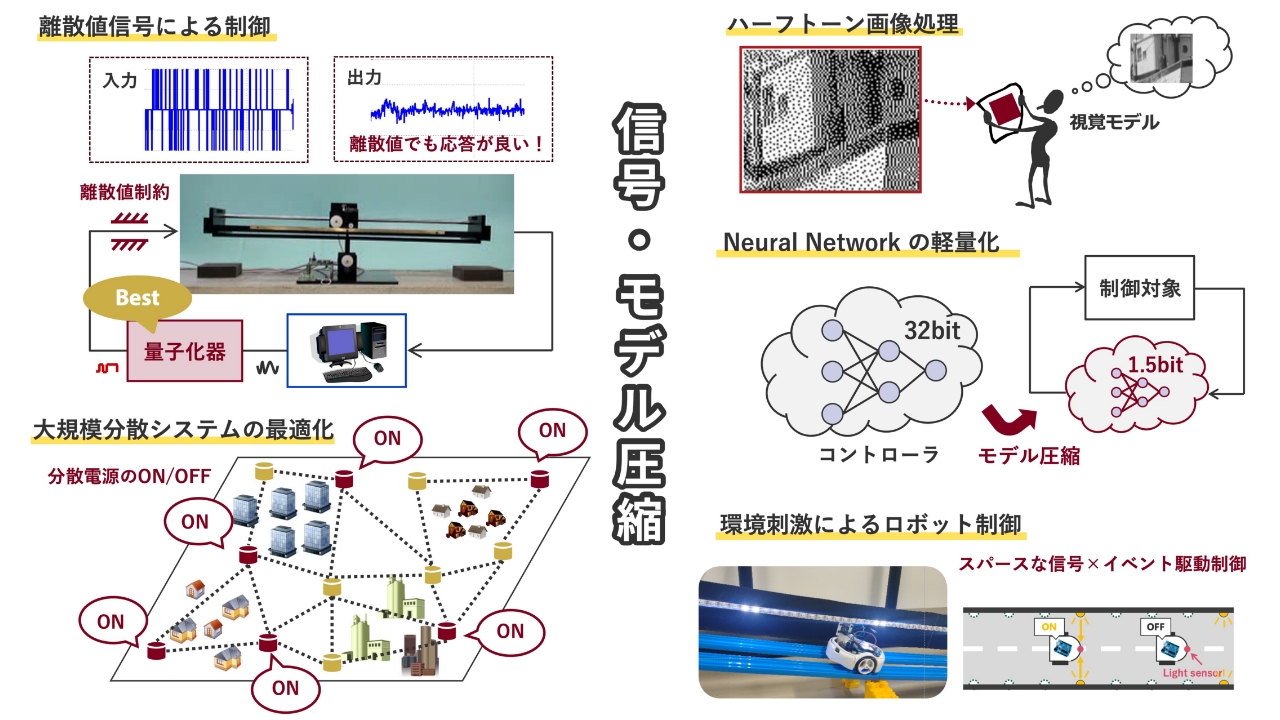
This research investigates technologies that enable accurate control even when only limited information is available. Because compressing signals or model information typically degrades control performance, the group proposes noise-shaping quantization, an approach that draws on model information to compress data intelligently while preserving control performance. The method is being extended to applications including robot control, image compression, distributed optimization, and neural-network compression.
Technologies Connecting Control Systems and AI
What students can learn
Working with physical simulators, ROS, MATLAB, and Python, students develop a grounding in AI technology and control theory alongside practical software skills gained through implementation and experiments.
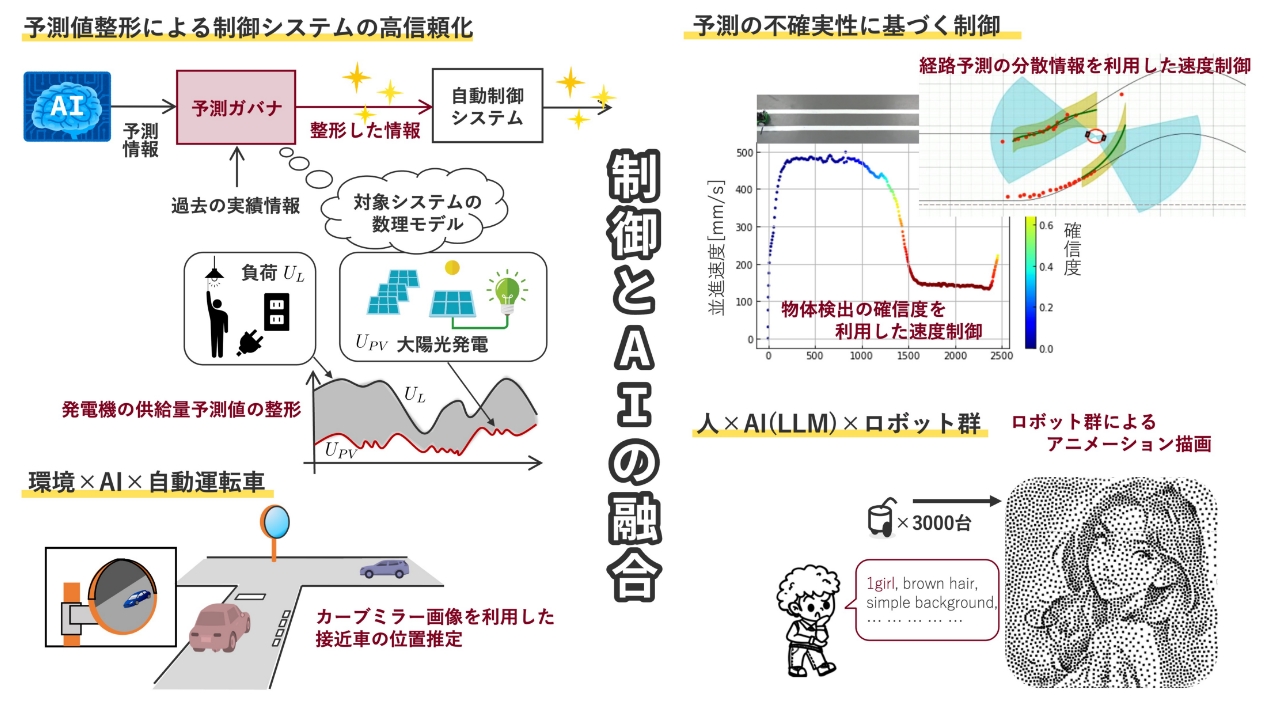
This research integrates control and AI to build AI-based control systems that draw on the strengths of both fields. Because AI predictions inevitably contain errors, the group develops a prediction governor that appropriately shapes predicted values to limit their impact on control performance. Potential applications include power systems and automated driving, and the research also explores uncertainty-aware AI prediction and the connections among AI, people, and the environment.