Developing New Light Sources by Combining Synchrotron Radiation and Lasers

What students can learn
Students can learn the principles of synchrotron radiation generation and how to handle light.
At the NewSUBARU synchrotron radiation facility, we are developing a new light source that combines a laser with an electron beam. By bringing together the excellent wavelength tunability of synchrotron radiation and the controlled phase of laser light, we aim to create an ultimate light source. Such sources are known as laser-seeded free-electron lasers and have become indispensable research tools. A distinctive feature of this research is the use of ultrashort laser pulses on the order of tens of femtoseconds together with a specialized undulator.
Control and Characterization of Ultrashort Light Pulses
What students can learn
Students can acquire methods for measuring ultrafast phenomena.
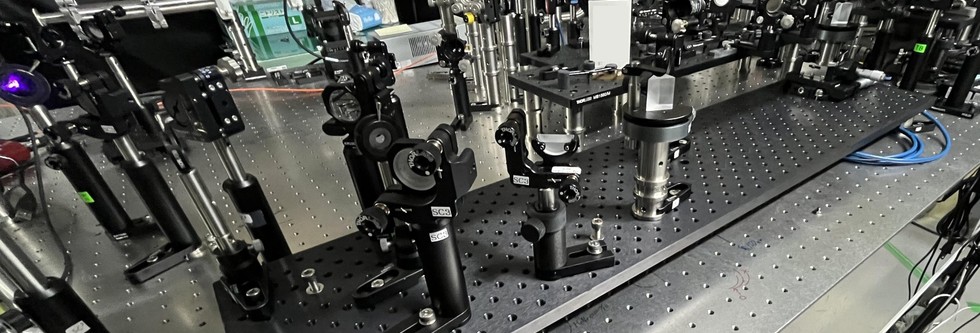
We characterize ultrashort light pulses whose emission duration is on the femtosecond scale, or one quadrillionth of a second. Because of the size of a synchrotron radiation facility, generated light must pass through thick glass windows and travel long distances through air before reaching an experimental hutch. Ultrashort pulses are highly susceptible to the effects of such media, which distort the light. We therefore design and build optical systems that reverse this distortion and instruments that measure the duration of ultrashort light pulses, allowing us to evaluate the light's original properties at the source.