Hajime Kishi
Professor | Ph.D. in Engineering
Applied Chemistry Course
Field of Applied Chemistry
Polymers are versatile materials that support clothing, housing, medicine, machinery, and electronic devices, and their role in society is expected to keep expanding in the years ahead. This research and teaching focus on enhancing the performance and functionality of polymeric materials, spanning topics from polymer synthesis to blending and fiber-reinforced composites, with the aim of developing environmentally friendly adhesives, composite materials, and functional materials.
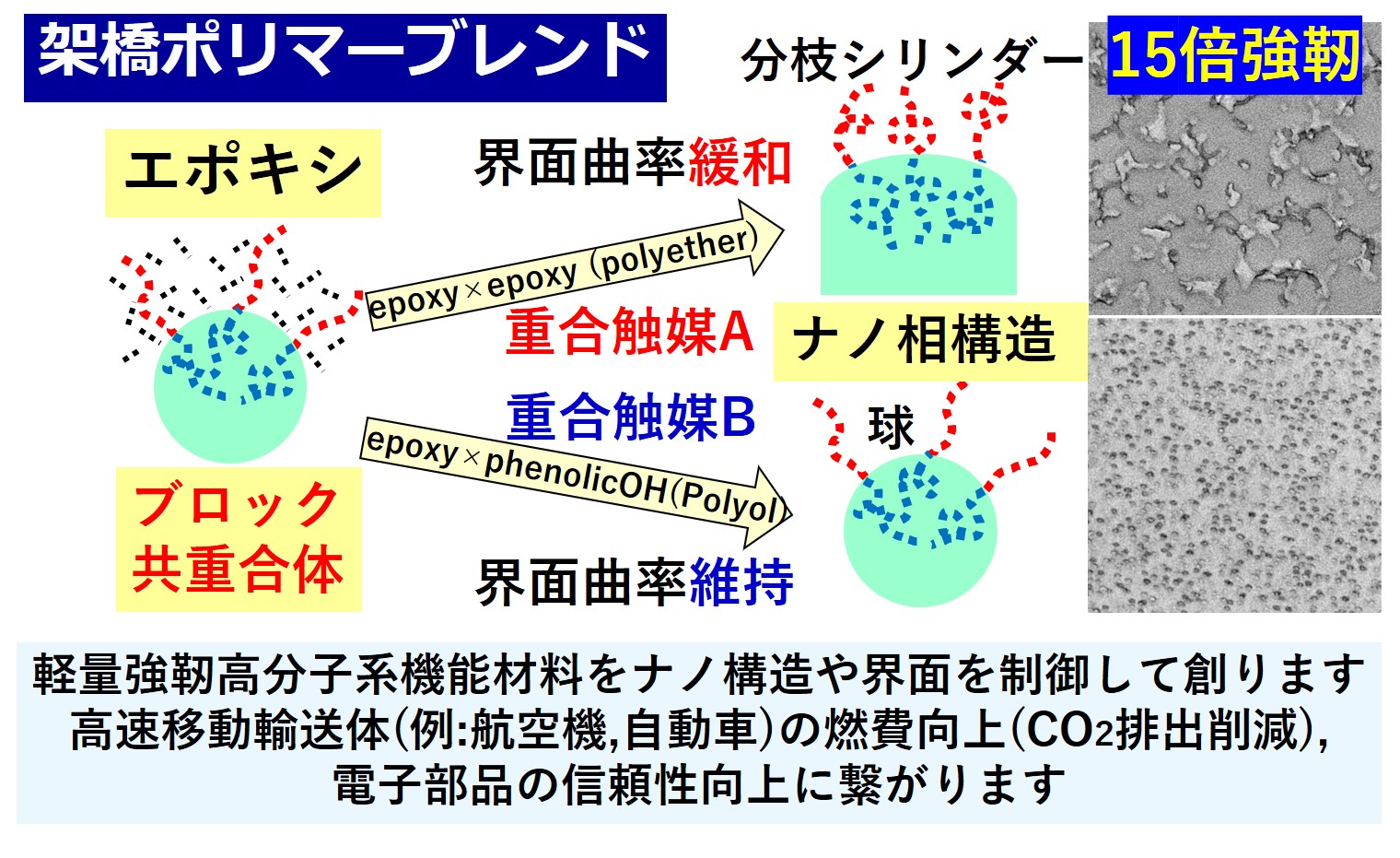
Tough Polymer Composites Enabled by Self-Organization
What students can learn
Students learn the theoretical principles behind blending multiple polymers—materials that would otherwise separate into coarse phases—into ordered structures at the nanoscale to microscale. In the process, they acquire the skills needed to design new functional materials of their own and gain insight into the mechanisms that produce tough, durable materials.
This research aims to develop polymer composites that are lightweight yet tough, resistant to deformation, and heat resistant. Such properties become achievable by blending multiple polymers—materials that do not ordinarily mix well—into regularly ordered nanoscale to microscale structures through self-organization. The resulting technology seeks to contribute to society by supporting energy savings and reducing CO2 emissions in high-speed transport such as aircraft, automobiles, and railway cars.
Electrically and Thermally Conductive Polymer Composites Enabled by Self-Organization
What students can learn
Building on the technique introduced above—regularly blending multiple polymers into nanoscale to microscale structures—students also examine the mechanisms specific to filler-based composites that give rise to their distinctive properties.
Building on the technique of regularly, and self-organizationally, blending multiple polymers that do not ordinarily mix well, this research explores the mechanisms by which metallic and inorganic fillers can be arranged within a polymer matrix. The work primarily supports the development of electronic materials and their adhesives, with the potential to enhance functionality, simplify manufacturing processes, and conserve resources.