Junichi Nishida
Professor | Ph.D. in Science
Applied Chemistry Course
Field of Applied Chemistry
Professor Nishida's teaching centers on organic chemistry and on the use of light to determine the structures of organic compounds. Rather than asking students to memorize organic reactions, he emphasizes understanding why each reaction takes place. In his lectures on structure determination, he explains, from first principles, the information that can be drawn from the wavelengths of light a compound absorbs. His research focuses on the functional properties exhibited by organic compounds containing multiple bonds, work he pursues as part of the Functional Organic Chemistry Research Group.
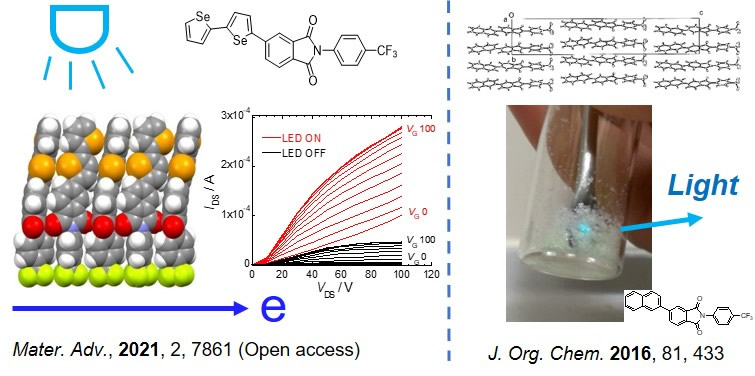
Synthesis of Organic Semiconductors and Luminescent Materials for Electronic Applications
What students can learn
Through this theme, students engage with organic photochemistry and organic electrochemistry, examine the mechanisms of photocatalytic reactions, and gain practical experience designing apparatus for experiments involving light- and electrolysis-driven reactions.
Professor Nishida's research is motivated by an interest in clean reaction chemistry that harnesses electricity and light. Redox-active organic compounds and complexes with stable ionic states can undergo electron-transfer reactions at an electrode, giving rise to changes in colour and other physical properties. His laboratory develops compounds that display electrochromic behaviour, in which a change in applied voltage produces a pronounced shift in colour. Among positively charged cationic dyes, some undergo photoinduced electron-transfer reactions and act as catalysts that oxidise other substances. More recently, he has been pursuing the development of clean organic chemical reactions that make use of visible light, a comparatively mild form of energy.
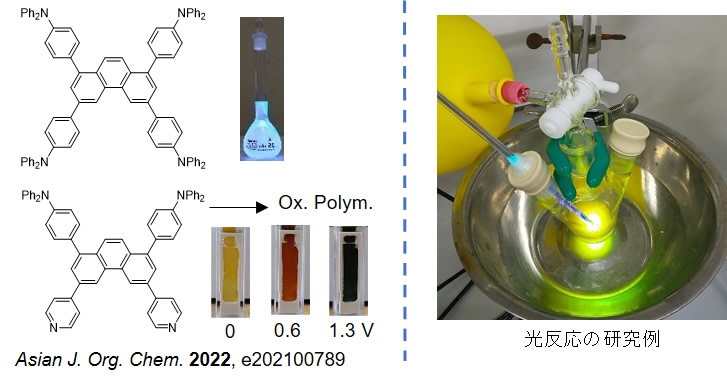
Clean Organic Reaction Chemistry Using Electricity and Light
What students can learn
Students working on this theme build a foundation in organic photochemistry and electrochemistry, come to understand how photocatalytic reactions proceed, and develop practical skills in designing equipment for light- and electrolysis-based experiments.
Professor Nishida's research is motivated by an interest in clean reaction chemistry that harnesses electricity and light. Redox-active organic compounds and complexes with stable ionic states can undergo electron-transfer reactions at an electrode, giving rise to changes in colour and other physical properties. His laboratory develops compounds that display electrochromic behaviour, in which a change in applied voltage produces a pronounced shift in colour. Among positively charged cationic dyes, some undergo photoinduced electron-transfer reactions and act as catalysts that oxidise other substances. More recently, he has been pursuing the development of clean organic chemical reactions that make use of visible light, a comparatively mild form of energy.