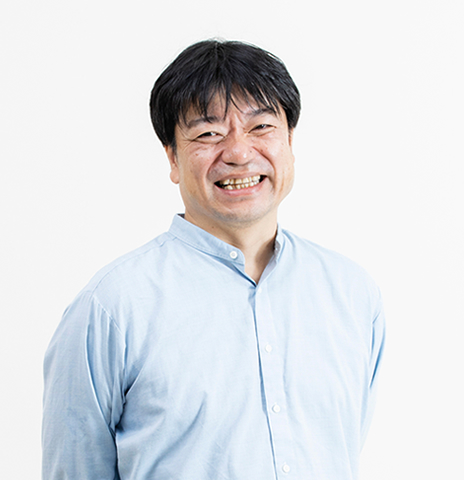
Kenji Iimura
Associate Professor | Ph.D. in Engineering
Applied Chemistry Course
Field of Applied Chemistry
His teaching covers reaction engineering, which applies mathematical modeling to the design of chemical-reaction-based production processes, and particle and powder technology, which explores the properties and behavior of powders. Chemical engineering, in essence, is about making manufacturing more efficient and creating materials with greater functionality. Within this field, his research focuses on how fine particles—the extremely small grains central to many chemical engineering processes—can be produced and put to practical use.
Enhancing the Supercooling of Water with Magnetic Ultrafine Particles
What students can learn
This theme introduces students to fabricating particles and precisely controlling their motion, revealing how such chemistry-based manipulation can, in turn, control the freezing behavior of water.
This research aims to develop technology that can freely control the temperature at which water freezes. By placing tiny magnetic particles in water and keeping them in continuous motion, the water resists freezing far below its normal freezing point and then freezes all at once. Ice formed this way consists of small, densely packed crystals. Because much of the quality loss in frozen food results from the growth of large ice crystals, producing finer ice may help preserve the original freshness of food even after thawing.
Controlling Crystal Formation with Nanobubbles
What students can learn
Students explore the properties of nanobubbles—extraordinarily small bubbles—along with the underlying principles that determine how these properties can be engineered for practical use.
Nanobubbles—bubbles of extremely small size—hold considerable promise, yet much remains unclear about exactly what they are effective for and why. As a foundational step toward the practical industrial application of nanobubbles, this research investigates the formation of salt crystals in the presence of nanobubbles. Their size and shape change measurably under these conditions, although the underlying reasons are not yet fully understood. Clarifying this mechanism may eventually make it possible to control crystal size and shape more precisely.