Mitsunobu Nakamura
Associate Professor | Ph.D. in Engineering
Applied Chemistry Course
Field of Applied Chemistry
In the classroom, fundamental principles and laws are presented in connection with other disciplines, familiar environmental issues, and cutting-edge research, with course content carefully designed to help students reach the learning goals central to chemistry education: the structure of the atom, the mechanism of chemical bonding, chemical reactions and reaction rates, inorganic and organic compounds, and the states of matter. Research centers primarily on DNA, seeking to understand its diverse and intricate functions and behavior in order to create new DNA-based functional materials that build on this understanding.
Molecular-Switch Fluorescent Probes Built from DNA
What students can learn
Students gain an understanding of the higher-order structure and function of DNA, along with a feel for molecular design and the organic synthesis skills needed to reproduce that function.
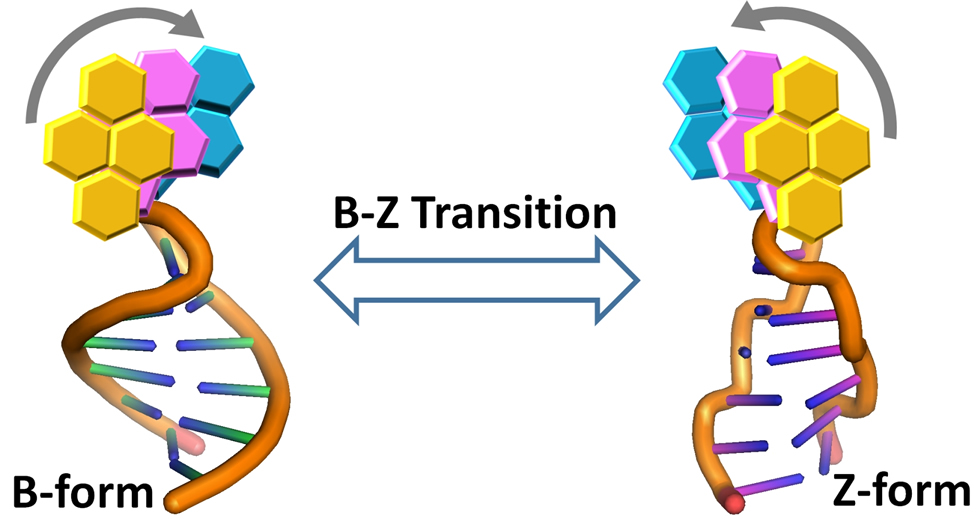
This research uses short DNA strands linked to fluorescent molecules to identify, through fluorescence, where various biological functions and interactions take place within living systems. Chirality is one of the fundamental features of the natural world and plays an important role both in elucidating life processes and in developing functional materials. Here, fluorescent molecules are arranged along the DNA helix to generate supramolecular chirality, with the aim of achieving fluorescence output that responds to switching in that supramolecular chirality triggered by biological functions or interactions. This approach may make it possible to pinpoint where such functions or interactions occur within living organisms.
Polymers Synthesized Using DNA as a Template
What students can learn
Students learn how weak intermolecular interactions within living systems influence biological function, while developing practical skills in sample handling and instrumental analysis.
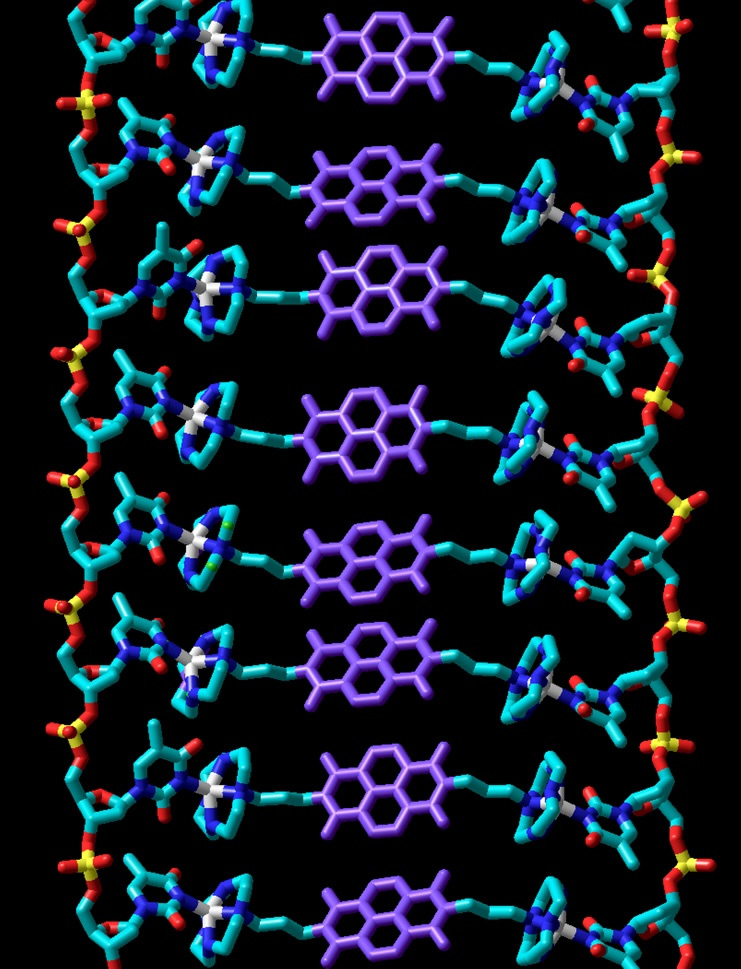
This research uses synthetic DNA as a template material, assembling polymerizable monomers modified with DNA base receptors into nanoscale molecular aggregates through self-organization, and carries out polymerization within these aggregates with the aim of controlling both the molecular weight and stereoregularity of the resulting polymer. Template polymerization allows polymerization in dilute solution together with control of stereoregularity, but conventional template materials are not easily synthesized with controlled molecular weight. By using synthetic DNA whose molecular weight can be precisely controlled as the template, this approach is expected to enable control over the molecular weight of the resulting polymer.