Mizuho Kondou
Professor | Ph.D. in Engineering
Applied Chemistry Course
Field of Applied Chemistry
Professor Kondou examines the properties of polymeric materials from a physicochemical perspective. Her work extends beyond the conventional polymers that have long served as substitutes for other materials, reaching toward next-generation polymers whose properties are beginning to surpass those of the materials they were originally designed to replace, and connecting these insights to ongoing research.
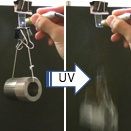
Liquid-crystalline plastics that change properties in response to light
What students can learn
Students learn to design molecules suited to a given purpose and to work toward the required performance, while also considering how the resulting materials might be used, what applications could follow, and what further properties would need to be understood to get there — approaching molecular function from multiple angles.
This research investigates plastic materials whose adhesive strength, hardness, and shape change in response to light. Because light can control these properties without physical contact, such materials are expected to be useful in vacuum environments and extremely confined spaces. Incorporating liquid crystals into these materials further improves sensitivity and output, and may enable responses not seen in conventional materials.
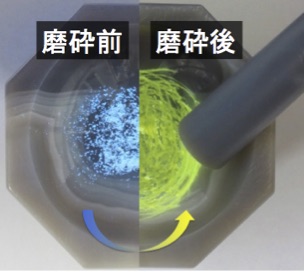
Materials that respond to friction
What students can learn
Students design the structure of dye molecules by considering electronic states and intermolecular interactions, and learn to identify the elements that give rise to a material's function while constructing the corresponding synthetic procedures.
These dyes exhibit reversible changes in color and emission color when rubbed. Friction is a macroscopic stimulus that people can apply directly, and it is intriguing that such a large-scale action can be translated directly into changes at the molecular level. Current work seeks to combine this response with other stimuli-responsive behaviors to develop further functions.