Shinji Yae
Professor | Ph.D. in Engineering
Applied Chemistry Course
Field of Applied Chemistry
Solid surface science and electrochemistry—the study of surfaces and interfaces where solids meet liquids or gases—form the core of the courses Professor Yae leads. His lectures draw connections to a wide range of familiar objects and phenomena, from jewelry, batteries, and smartphones to large bridges and ships, as well as detergents and exhaust-gas purification catalysts. His research group has continued work on electroplating for more than seventy years. Current research centers on the surface treatment and processing of silicon—the semiconductor material used in solar cells and ULSI devices—together with plated films and the hydrogen present in metals in trace amounts.
Metal Nanoparticles That Etch Pores into Silicon
What students can learn
Through wet-process techniques—that is, aqueous-solution-based treatments—for fabricating noble-metal nanoparticles on silicon semiconductors and etching them, together with structural observation and reaction analysis, students develop a grounding in semiconductor fundamentals and handling, along with practical skills in instrumentation such as electron microscopy and electrochemical measurement.
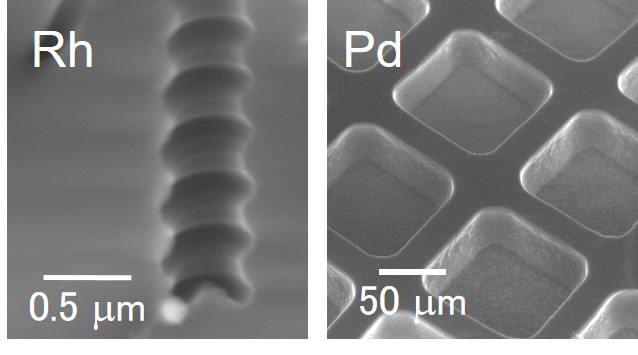
This research investigates the fine-scale processing of silicon through metal-assisted chemical etching, in which a semiconductor bearing metal particles is immersed in solution. Simply immersing the silicon in two solutions in sequence deposits noble-metal nanoparticles—some as small as five nanometers—onto its surface through plating; these particles then act like the tip of a drill bit, etching minute pores into the silicon. When such pores form densely, the surface darkens, a property that may help improve the energy conversion efficiency of solar cells, while the ability to readily produce pores of varied, well-defined shapes points to applications in highly productive microfabrication. The research aims to understand the underlying reaction mechanism in order to achieve a high degree of control over it.
Recovering Precious Metals from Urban Mines Using Waste Materials
What students can learn
As in the first research theme, students build skills in handling semiconductors, operating laboratory instruments, and performing electrochemical measurements, while additionally learning techniques for the chemical analysis of solutions.
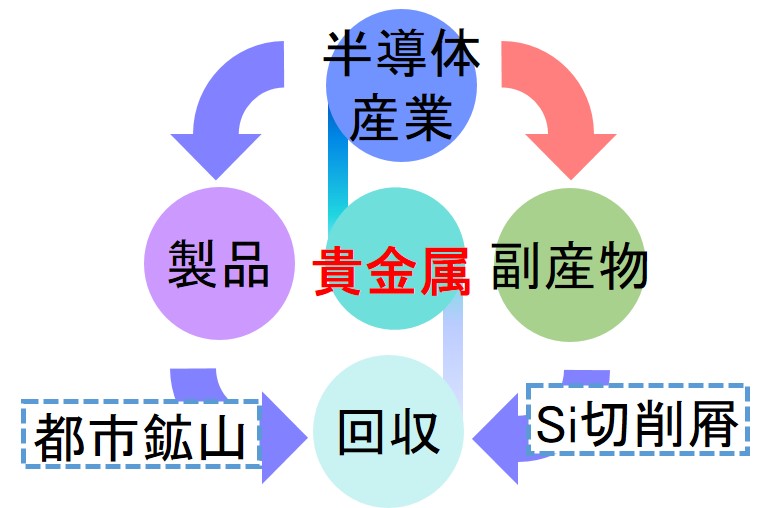
This research seeks to establish a recycling loop that recovers precious metals from urban mines using discarded semiconductor materials. Obsolete electronic waste—old smartphones, computers, and the like—contains precious metals at concentrations higher than those found in natural ore, which is why such waste is referred to as an urban mine. At the same time, the manufacture of semiconductor devices for electronics generates large quantities of discarded silicon powder. By applying this silicon powder to wet-process precious-metal recovery, the research has achieved recovery that is both faster and more efficient than previous methods. The work aims to separate individual precious metals from one another through careful control of the reaction.