Fumiya Kidena
Assistant Professor | Master of Engineering
Department of Engineering, Mechanical Engineering Course
Mechanical Engineering Field, Fluid Engineering Research Group
My research uses numerical simulation to elucidate flows in which gases and liquids intermingle (multiphase flows), including fuel-spray atomization, evaporation and combustion, and sea spray.
In lectures, I hope to help students connect formulas and equations with physical phenomena. In the laboratory, I also share numerical-simulation expertise that supports this kind of inquiry.
Capturing Droplet Breakup through Numerical Simulation

What students can learn
Students can learn computational fluid dynamics (CFD), computational methods for flows in which gases and liquids intermingle (multiphase flows), data visualization, programming, and large-scale computing using supercomputers.
This research uses numerical simulation to elucidate atomization, the process by which a liquid breaks into fine droplets. We study phenomena such as bag-mode breakup, in which a droplet exposed to a high-speed gas flow inflates like a bag and bursts, and also develop computational methods for accurately resolving flows in which gases and liquids intermingle (multiphase flows). Atomization is important not only in a wide range of engineering applications but also as an element of Earth's environmental cycles through rainfall and the generation of sea spray.
Predicting the Evaporation and Combustion Behavior of Liquid Fuels
What students can learn
Students gain knowledge of computational fluid dynamics (CFD), the fundamentals of heat transfer, species transport, and combustion, programming, and large-scale computing using supercomputers.
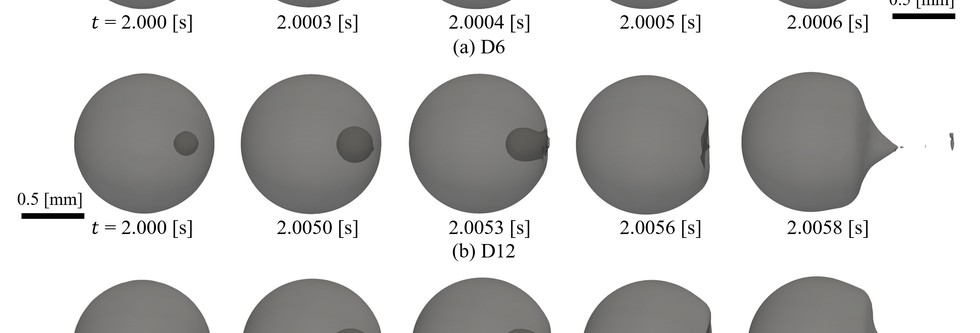
When a droplet composed of a multicomponent fuel is heated, sudden boiling inside it can cause a phenomenon known as puffing, in which liquid is ejected. This research uses numerical simulation to analyze how puffing affects droplet evaporation and atomization. If calculations can predict when and how a droplet bursts and breaks into smaller droplets, this can help realize clean, energy-efficient combustion that uses fuel without waste and produces fewer emissions.