Hiroshi Kinoshita
Professor | Ph.D. in Engineering
Mechanical Engineering Course
Field of Mechanical Engineering
In his lectures, Professor Kinoshita goes beyond formalized content to trace the historical development of each field, an approach intended to help students grasp the true essence of engineering. His research investigates devices and control systems that draw on the structures of biological and inorganic materials and the properties those structures confer, work that gives his research group its name.
Application of Graphene Oxide as a Lubricant Additive
What students can learn
Students learn the properties of nanomaterials together with the principles underlying friction and lubricating oils.
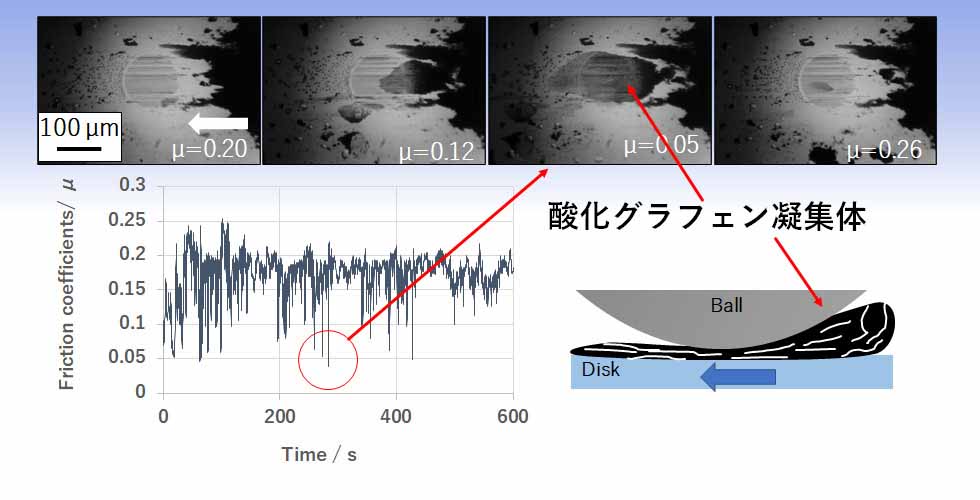
Lubricating oil alone cannot achieve sufficiently low friction or wear, so a variety of molecules are blended in as additives to compensate. However, with the low-viscosity lubricants now in wider use, conventional molecular additives no longer perform effectively enough, creating demand for nanomaterial additives that combine exceptional strength with low friction. This research uses graphene oxide, a comparatively inexpensive option, as such an additive. Recent work has revealed that aggregating graphene oxide before use produces a markedly greater reduction in friction.
In Situ SEM Observation of Friction Interfaces
What students can learn
Students learn the imaging mechanism and operation of scanning electron microscopy, along with the principles of friction.
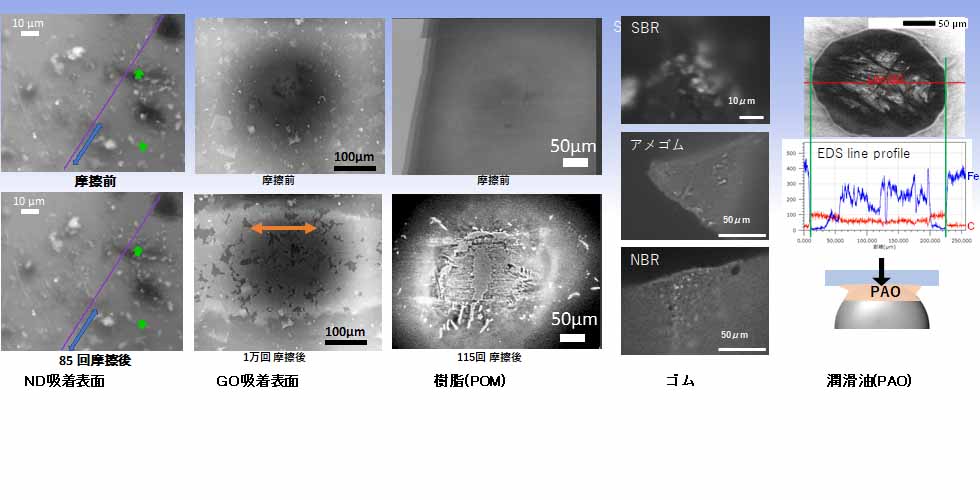
Friction arises at the interface where two surfaces slide against one another. Science has advanced through observation and analysis, yet the friction interface is exceptionally difficult to observe and analyze because it is sandwiched between opaque materials such as metal. The phenomenon itself is also so minute that it can only be seen under an electron microscope. Until now, researchers have been limited to optical microscopy, but this laboratory has developed an apparatus that uses an electron-transparent film as the friction substrate, allowing the counter material to be observed directly with a scanning electron microscope (SEM). This approach has revealed phenomena never before observed anywhere in the world.