Ippei Tanaka
Associate Professor | Ph.D. in Engineering
Mechanical Engineering Course
Field of Mechanical Engineering
Cultivating independent thinking and hands-on creativity lies at the heart of Associate Professor Tanaka's teaching, encouraging students to explore ideas through their own effort. His research focuses on thin films ranging in thickness from micrometers down to less than a hundredth the width of a human hair, at the nanometer scale, with the aim of improving the energy efficiency and extending the service life of tools, dies, and mechanical components, alongside developing the equipment needed to fabricate such films.
Creation of Ultra-Hard Thin Films

What students can learn
In addition to thin-film fabrication techniques, students learn to design and develop equipment that draws on a broad range of knowledge spanning electrical engineering, chemistry, and materials science.
This research investigates carbon nitride, a material whose existence has never been conclusively confirmed but which is theorized to be harder than diamond. To synthesize carbon nitride, the laboratory has built a new plasma-based coating apparatus and studies the resulting thin films' hardness and frictional properties. Harder materials wear more slowly under friction, so coating the surfaces of tools and dies with a micrometer-scale carbon nitride film could, in principle, produce exceptionally long-lasting, next-generation cutting tools.
Application of Diamond to Mechanical Components
What students can learn
Students also gain knowledge of friction and wear, together with materials-analysis techniques such as electron microscopy, X-ray diffraction, and photoelectron spectroscopy.
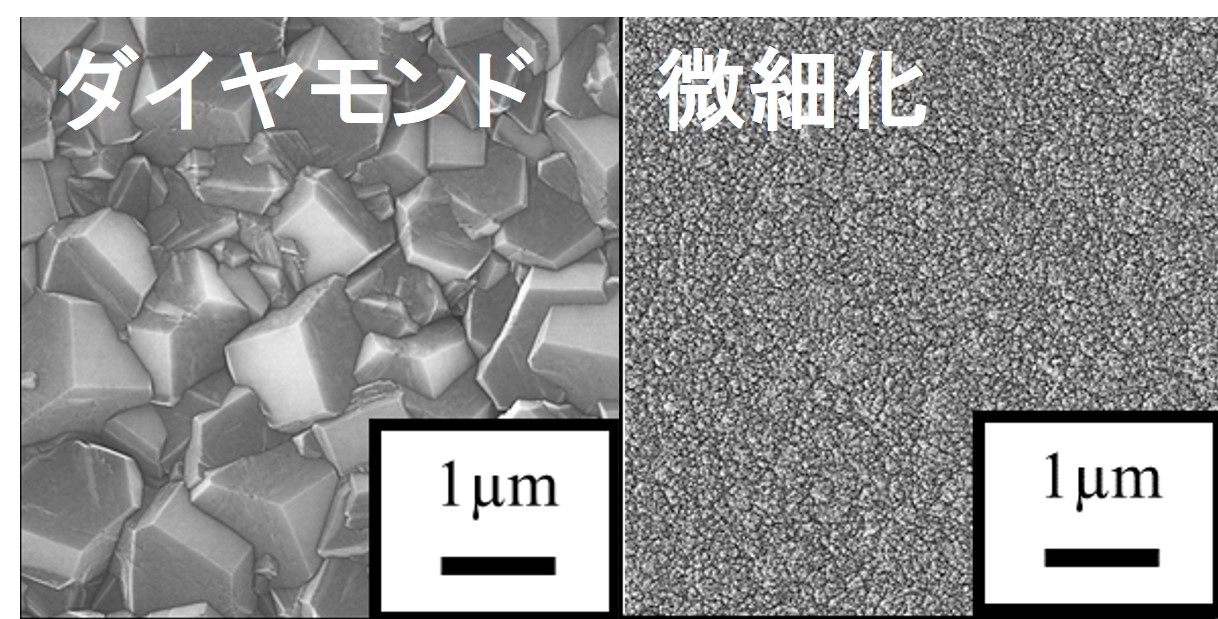
This research develops growth-control techniques for diamond films aimed at applying diamond to automotive components in order to reduce friction and wear. Diamond can be deposited by decomposing methane and hydrogen gas through heat or plasma, and this work is developing new gas-decomposition methods with the goal of achieving high-speed coating alongside precise control of film growth. Diamond films typically form with a rough surface, and refining this surface at a finer scale is expected to combine low friction with high wear resistance, potentially improving the energy efficiency and extending the service life of friction-critical components.