Masaharu Kuroda
Professor | Ph.D. in Engineering
Mechanical Engineering Course
Field of Mechanical Engineering
In his teaching, Professor Kuroda teaches mechanical dynamics and focuses on achieving a balance between abstract concepts and practical applications to help students master the principles of mechanical dynamics. In his research, he conducts fundamental studies on the engineering applications of fractional calculus and nonlinear dynamics and aims to develop control methods for these areas.
Vibration Control Using Fractional Calculus
What students can learn
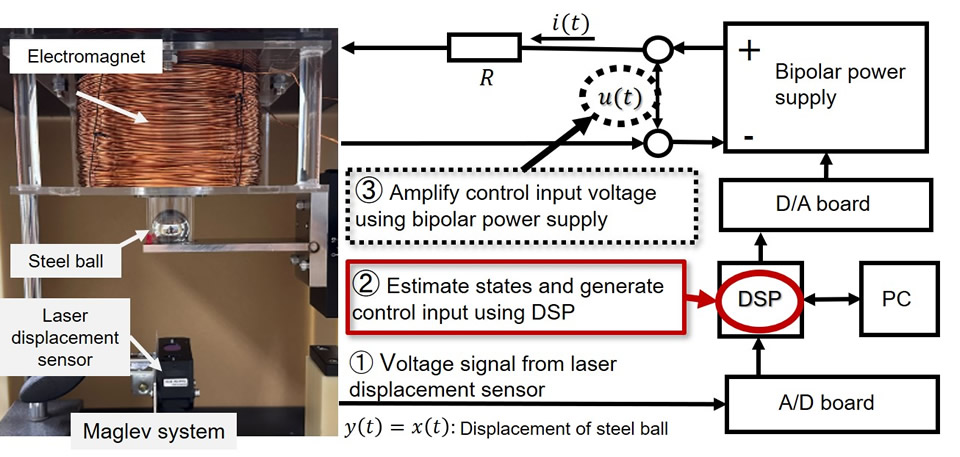
Students can learn about vibration control using active wave control and fractional-order LQR control—techniques not achievable with conventional calculus—as well as methods for implementing these control systems using digital signal processors (DSPs).
We've been studying integer-order calculus—such as "first-order differentiation" and "second-order integration"—ever since high school, but in fact, non-integer-order calculus can also be defined. Among these, he is researching fractional calculus, which holds great potential for engineering applications. Specifically, he is working on the dynamics and control of systems whose equations of motion can be described using fractional calculus. In particular, he starts by setting up simple experimental systems to demonstrate fractional-order differential responses, with the overall goal of controlling vibrations in mechanical systems. The figure shows an experimental setup in which fractional-order servo LQR control is applied to a magnetic levitation system.
Nonlinear Engineering: Engineering Applications of Nonlinear Dynamics Including Chaos
What students can learn
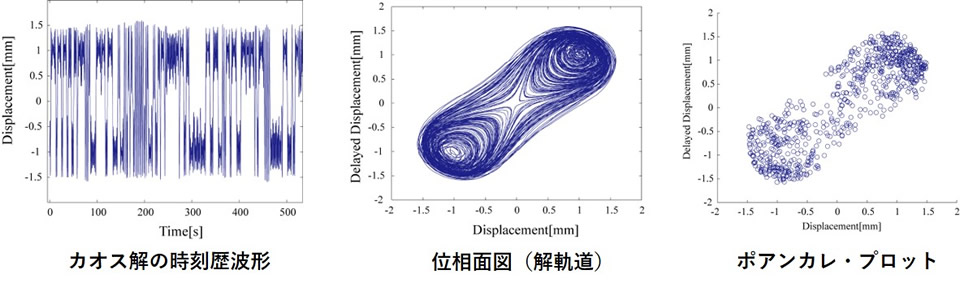
Students can develop the ability to properly model nonlinear dynamics and the insight to apply them in engineering.
Chaos, solitons, and pattern formation phenomena are prominent and attractive topics in the field of nonlinear dynamics. In this research, we go beyond theoretical analysis and numerical simulations to also conduct studies using a simple experimental setup, with the goal of exploring mechanical engineering applications of chaos, solitons, and pattern formation phenomena, as well as the positive and constructive utilization of nonlinearity. The figure shows a chaotic time series, its phase space portrait, and a Poincaré plot.