Masahiro Kusaka
Associate Professor | Ph.D. in Engineering
Mechanical Engineering Course
Field of Mechanical Engineering
Deformation and strength of structural materials under diverse mechanical loads and temperature changes form the foundation of manufacturing engineering, and Kusaka's teaching and research are built around these themes. His courses include Mechanics of Materials and Solid Mechanics, with an emphasis on extensive practical exercises that cultivate applied problem-solving skills. His research investigates the strength evaluation of joints between dissimilar materials.
Evaluating the Delamination Strength of Thin-Film Coatings
What students can learn
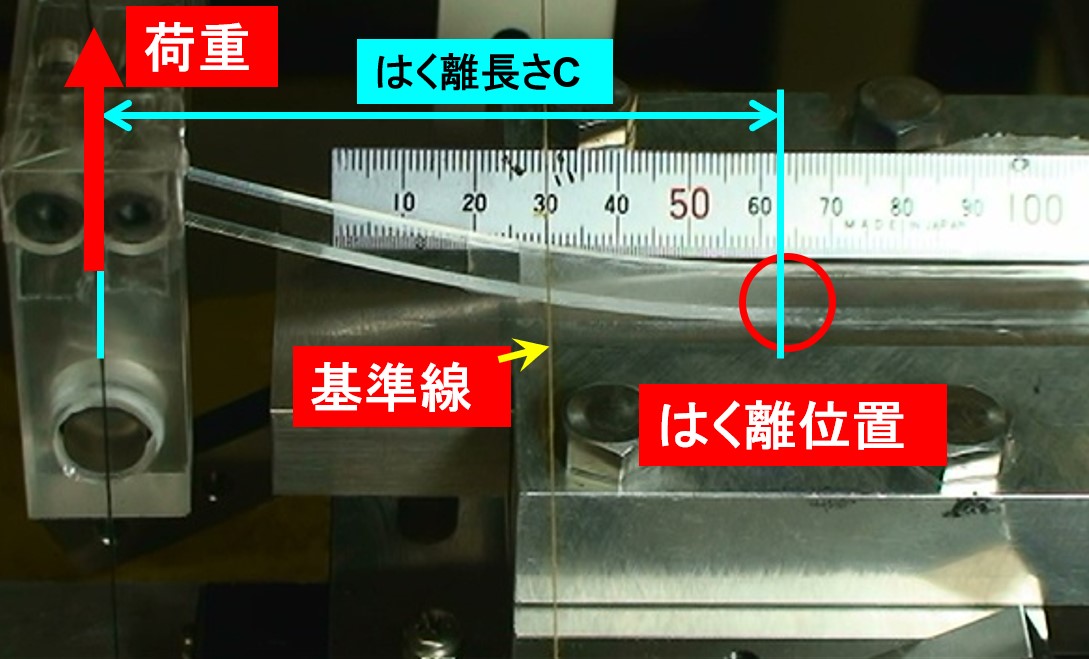
Through peel testing, students gain hands-on familiarity with the principles and operation of materials testing machines and various measurement instruments. Delamination simulations further develop their command of finite element analysis.
Components with composite structures combine materials of differing properties, making mechanical evaluation at the bonded interface essential. This research applies fracture mechanics to establish a rational method for assessing bond strength: the delamination strength of coatings that peel under large deformation is examined through fracture-mechanics analysis, drawing on both peel experiments and simulation results. A rational evaluation of delamination strength supports the informed selection of optimal coating materials, coating dimensions, and bonding techniques.
Development of Actuators Combining Superelastic and Ferromagnetic Materials
What students can learn
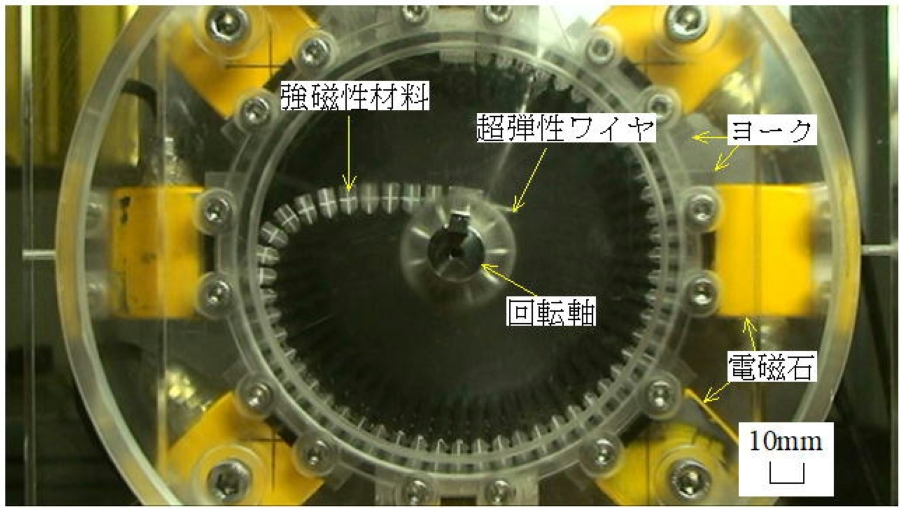
Students build simulation skills applied to optimizing composite geometries and analyzing the operating mechanisms of actuators.
This research pursues magnetically driven actuators that exploit the large-deformation behavior of superelastic shape-memory alloys together with the magnetic forces generated in ferromagnetic materials. Achieving high load capacity requires optimizing the geometry of the composite formed from these two materials, a task addressed through simulation. The resulting actuator is envisioned as a compact, high-load-capacity torque actuator for aerospace applications.