Masayuki Nunobiki
Associate Professor | Ph.D. in Engineering
Mechanical Engineering Course
Field of Mechanical Engineering
In his lectures on the production processing technologies that underpin manufacturing (monozukuri), Professor Nunobiki emphasizes not the rote memorization of terminology and formulas, but the historical development of these technologies and the connections among them, so that students come to understand the likely direction of future technological progress. His research addresses the advancement of production processing technologies and the transmission of the tacit skill—the artisan's craft (takumi no waza)—possessed by experienced craftspeople, a focus that gives his research group its name.
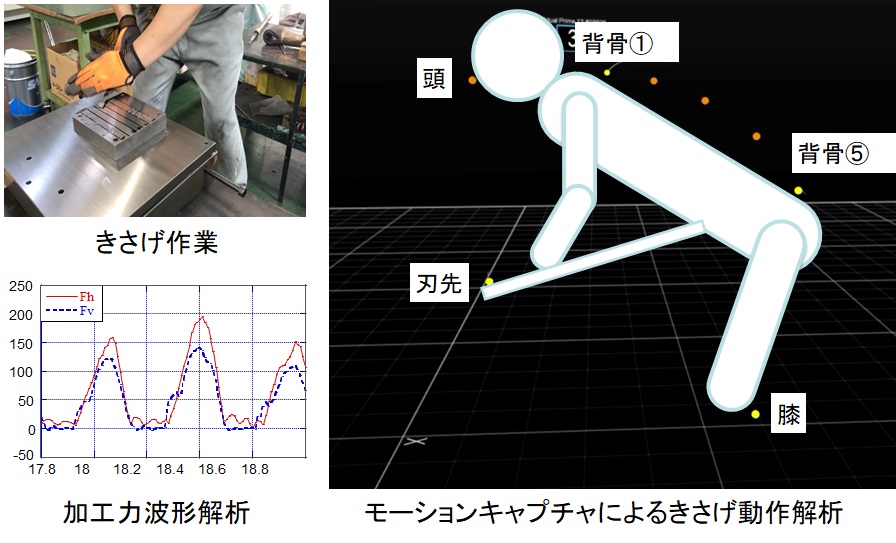
Research on a Support System for Transmitting Kisage (Hand-Scraping) Skills
What students can learn
Students engage with motion-analysis techniques based on motion capture, together with artificial-intelligence methods such as reinforcement learning and clustering.
This research aims to develop a system that supports the transmission of skill in kisage, a manual hand-finishing technique. To clarify the relationship between a worker's body movements and the resulting finishing quality, the work employs motion analysis based on motion capture and seeks to visualize the tacit, sensory knowledge—the intuition and knack—on which skilled workers rely. More than a decade has passed since the loss of artisans' expertise upon retirement was first identified as a problem, yet no effective countermeasure has been established; this research is expected to contribute both to the training of young technicians and to the further skill development of experienced craftspeople.
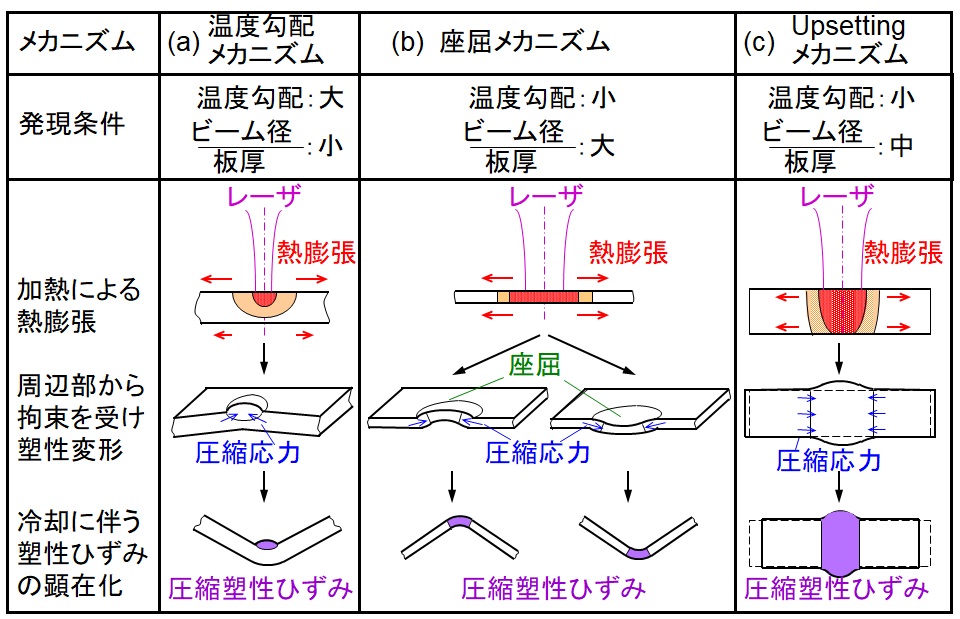
Research on Repairing Dents in Metal Sheets Using Laser Forming
What students can learn
Students gain familiarity with laser forming, a technique that deforms metal sheets through laser irradiation, and with the heat-transfer and structural analysis methods used to evaluate it.
This research seeks to develop a technique for repairing dents in metal sheets by means of laser forming, whereby irradiating a metal sheet with a laser beam under suitable conditions causes it to bend. Heat-transfer and structural analysis software is used to determine laser-irradiation conditions that offset the compressive and tensile plastic strains localized around a dent. Beyond repairing dents in automobile bodies, this technique can also produce fine surface textures on the glossy surfaces of smartphones and household appliances, suggesting its potential as a novel decorative-finishing method.