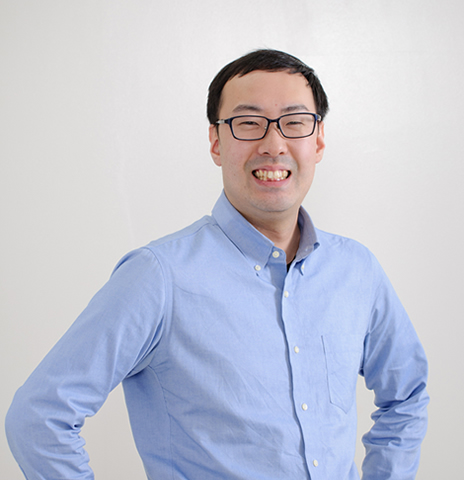
Yusuke Tsunoda
Assistant Professor | Ph.D. in Engineering
Mechanical Engineering Course
Field of Mechanical Engineering
Grounded in control engineering, Yusuke Tsunoda values both theoretical analysis and experimental verification, and strives to teach in a way that conveys the fascination of control through both approaches. His research centers on the development of biomimetic robots, swarm robotic systems, swarm intelligence, disaster-response robots, and robots for traversing rough terrain — work that gave rise to the name of his laboratory, the Field Swarm Robotics Laboratory. The Tsunoda Laboratory offers students the opportunity to design and build a robot that is truly their own, unlike any other in the world.
Elucidating Swarm Intelligence through Control Theory and Its Application to Artificial Systems
What students can learn
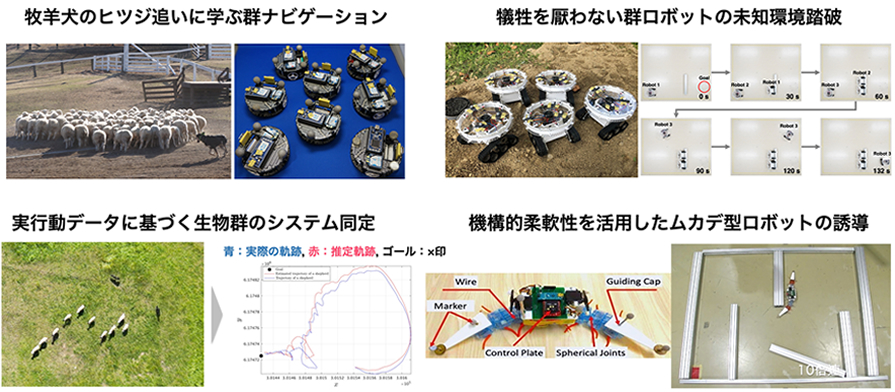
Students gain practical expertise in observing and measuring animal swarms, image processing, behavioral modeling based on measured data, AI-based data analysis, and the development of biomimetic robots.
This research investigates, from the standpoint of control theory, the mechanisms underlying the intelligent behavior that living organisms have acquired through evolution, and applies these principles to artificial systems such as robots. The work involves observing the behavior of animals that form swarms, employing control theory to uncover the logic behind that behavior, and developing "intelligent" robots modeled on these biological systems. Through this research, Tsunoda aims to establish control principles that enable robots to move robustly and adaptively in unfamiliar environments — a challenge for conventional robots — thereby realizing foundational technologies of benefit to society.
Development of Swarm Robotic Systems for Extreme Environments
What students can learn
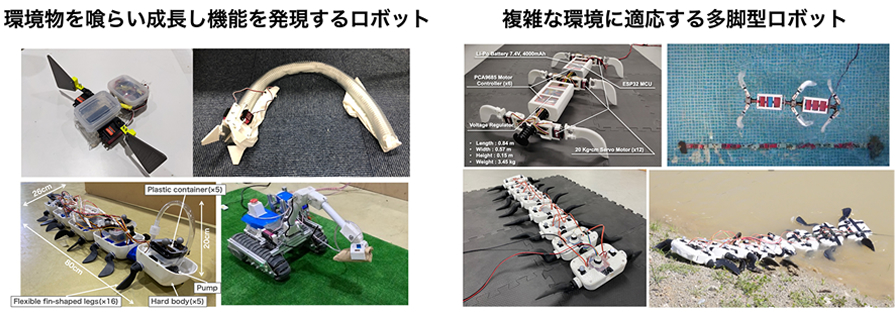
Students acquire comprehensive skills across the three core elements of robot development: hardware (machine tools, 3D CAD, and 3D printing), software (MATLAB, ROS, and Python), and electronics (circuit board design).
This research develops swarm robotic systems capable of performing tasks on behalf of humans in extreme environments such as landslide disaster sites and the lunar surface. Rather than relying on conventional large, heavy construction machinery, the work explores fleets of compact robots, each with distinct functions, to carry out recovery operations and infrastructure construction. Through this approach, Tsunoda seeks to pioneer new earthwork technologies and to realize robots that genuinely assist people.