Daichi Eguchi
Associate Professor | Ph.D. in Science
School of Engineering, Materials Design Course
Materials Design Field, Nanomaterials Research Group, Graduate School of Engineering
In my lectures, rather than merely explaining textbook content, I also introduce related cutting-edge research findings. I strive to help students experience how what they learn in class directly connects to research.
My research precisely designs nanomaterials to draw out their full potential, which is the origin of our research group's name.
Designing Nanomaterials to Unlock Their Full Potential

What students can learn
Students can learn the entire process from nanomaterial design and synthesis to structural analysis using synchrotron radiation facilities and other techniques, as well as physical-property evaluation.
We believe that nanomaterials have the potential to transform our lives, for example by enabling solar cells that surpass theoretical limits. Realizing such possibilities requires drawing out the full potential of nanomaterials. Our research group consistently carries out nanomaterial synthesis, structural analysis using synchrotron radiation facilities and other techniques, and physical-property evaluation. We then feed the results back into the next materials design cycle. By continually repeating this cycle of synthesis, structural analysis, and property evaluation, we seek to unlock the potential of nanomaterials.
Stronger Together? Toward Cooperative Effects in Nanomaterials
What students can learn
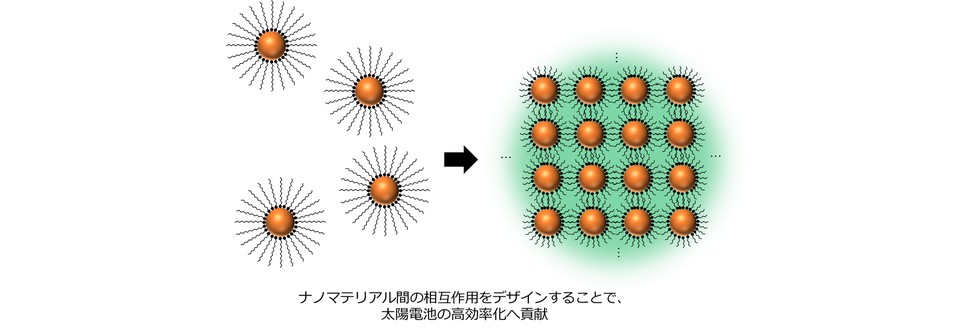
Students can learn about cooperative effects that emerge when nanomaterials assemble.
A synergistic effect means that one plus one produces more than two, a phenomenon observed in sports and many other everyday settings. Communication, or interaction, between individuals is the key to such synergy. Likewise, by designing interactions among nanomaterials, we can expect new properties that far exceed those of the individual materials. Our research group precisely controls these interactions among nanomaterials to contribute to improving solar-cell efficiency.