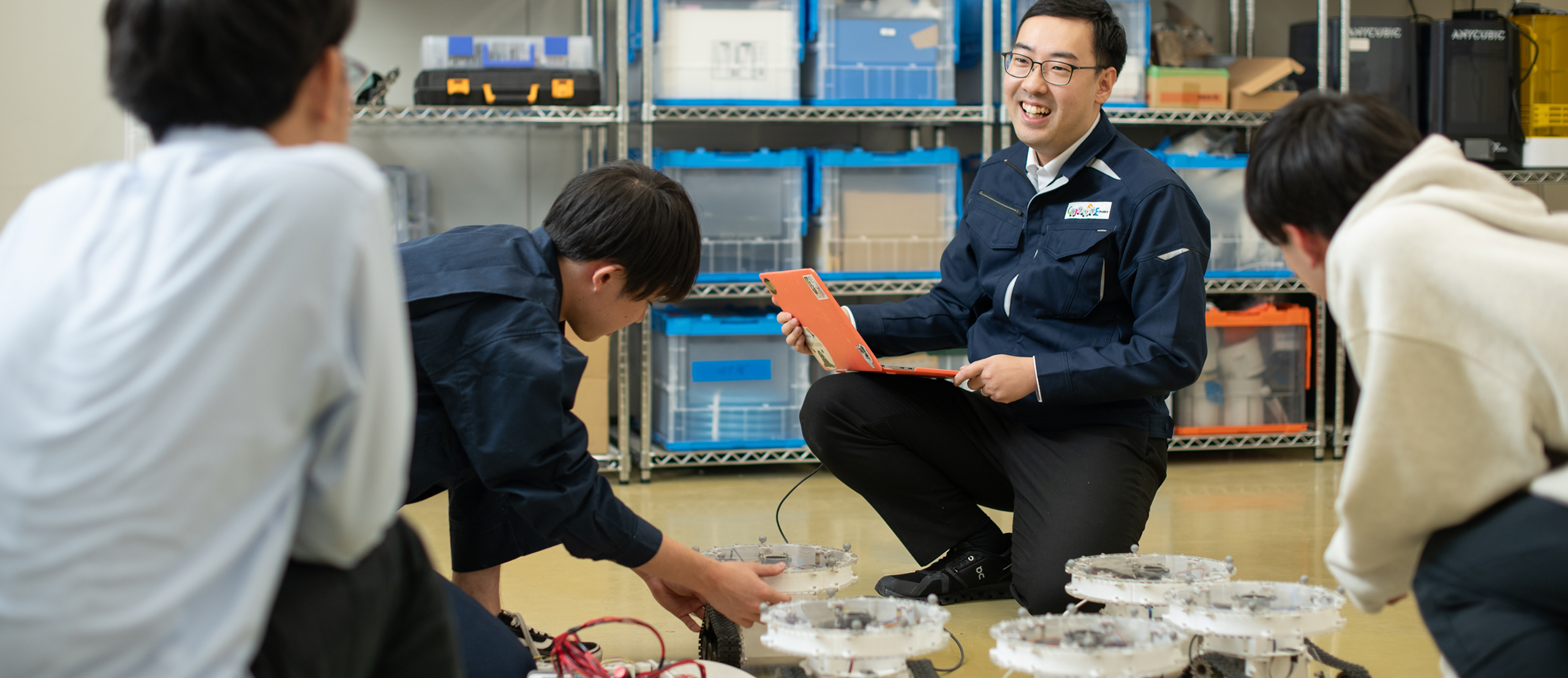
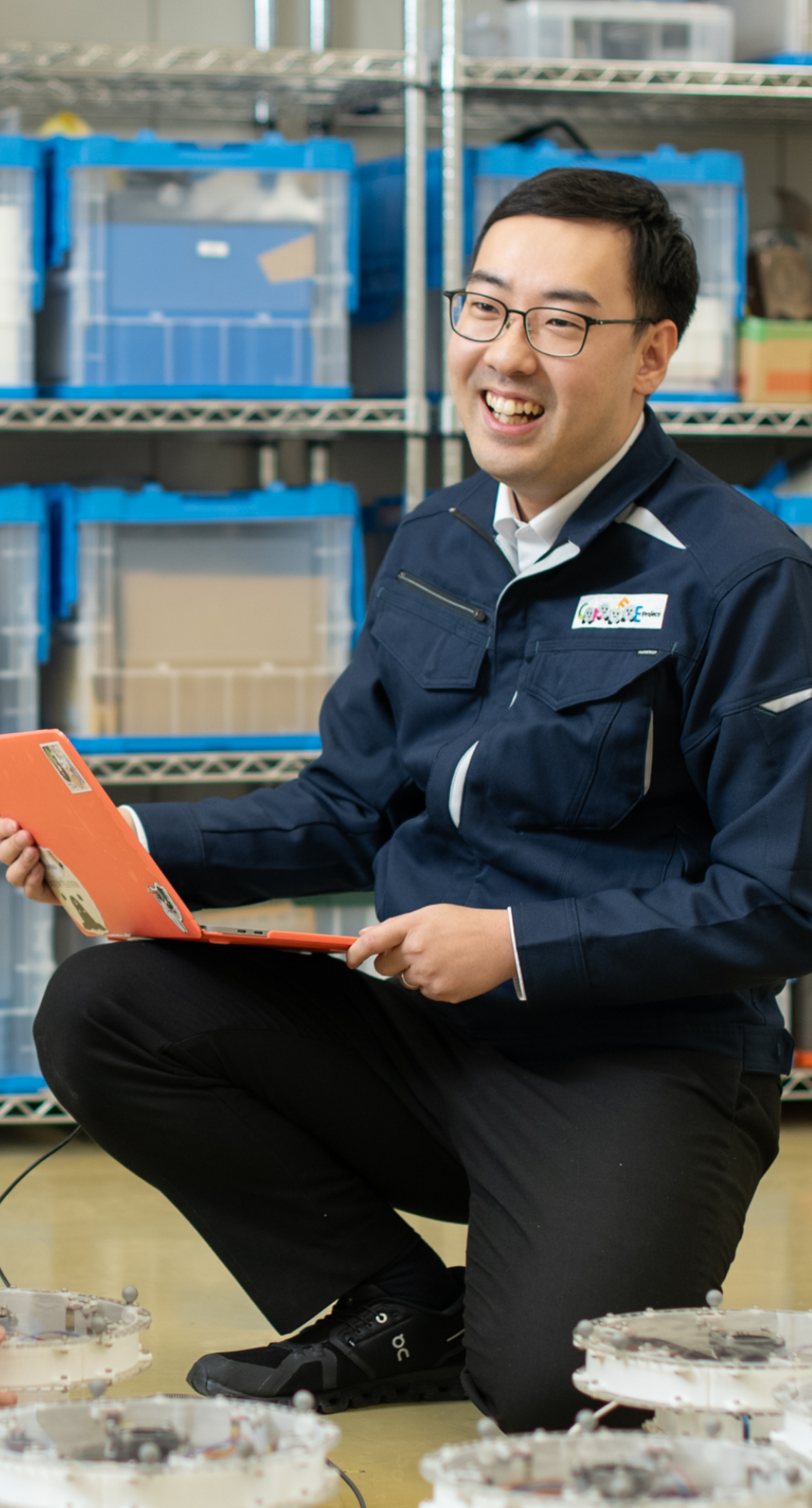
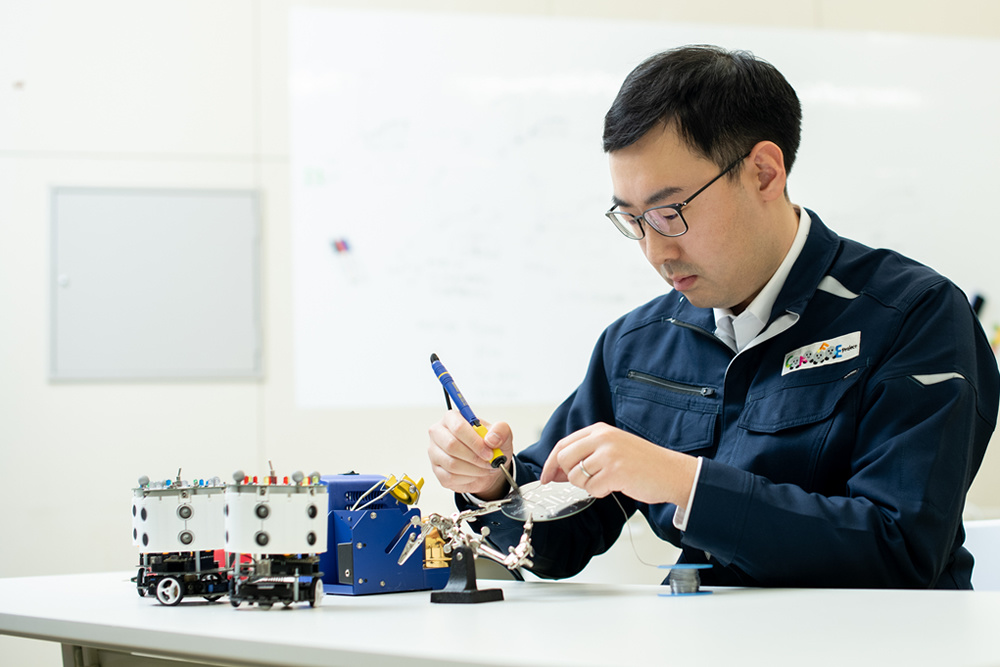
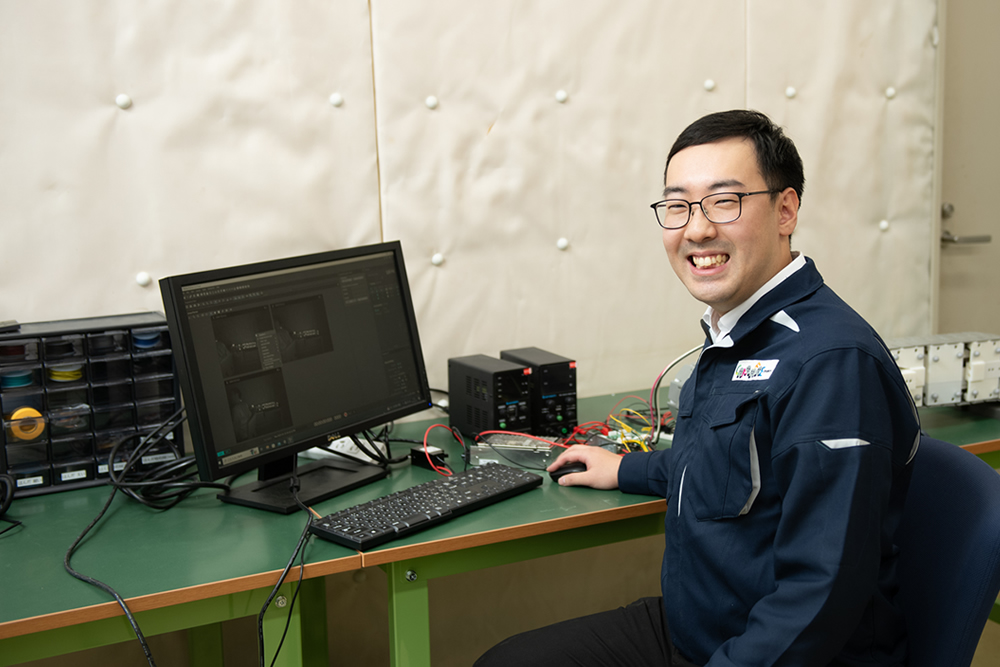
We aim to establish a design theory for swarm robot systems that perform effectively in harsh environments such as landslide disaster sites and the lunar surface. We approach this from multiple angles, including biomimetics, control theory, and nonlinear dynamics.
There is a growing need for swarm robot systems where multiple robots work together in harsh areas inaccessible to humans, such as landslide disaster sites or the lunar surface. However, conventional robot design methods enable operation in clean indoor environments but fail to function effectively in complex outdoor environments (unspecified environments) that change unpredictably and constantly. In response, we are conducting research aimed at developing a design methodology for autonomous distributed control of swarm robot systems that can thrive in unspecified environments, inspired by organisms that adapt and survive in natural environments.
We are developing a highly scalable swarm navigation system inspired by the phenomenon of ‘sheep herding by shepherds,’ where a small number of shepherds perform navigation of a large flock of sheep. This system uses a minimal number of simple controller robots to guide a large swarm of robots. Additionally, to prevent getting stuck in unspecified environments, we are developing the “i-CentiPot-Amphibian,” an amphibious centipede-like mobile robot with a flexible body and multiple legs. We are also designing navigation methods for unknown environments that maximize the advantage of having a large number of robots. We are also developing novel robots that defy conventional robotic wisdom, such as the flexible, bendable crawler robot “d-FlexCraw” and the “GREEMA” robot, which consumes environmental materials like soil and water to grow and manifest its functions.
Developing design methodologies for robot swarms capable of operating robustly in unspecified environments will lead to the creation of swarm robot systems that can be practically useful in various scenarios, such as search and rescue operations at landslide disaster sites and infrastructure construction on the moon. It will also contribute to biological insights, including the understanding of living organisms.

| Research | ||
|---|---|---|
| Journal | Transactions of the Institute of Systems, Control and Information Engineers | |
| Title | Design of Mobile Control for Multiple Agents Inspired by Sheepdog Shepherding and its Verification | |
| Author | Yusuke Tsunoda, Yuichiro Sueoka, Teruyo Wada, Koichi Osuka | |
| Member | Yusuke Tsunoda, Department of Mechanical Engineering, Graduate School of Engineering | |
| URL | https://www.jstage.jst.go.jp/article/iscie/34/7/34_191/_article/-char/en | |
| Remarks | Lab.HP: https://sites.google.com/view/tsunoda-lab-fsr | |
| Joint and Contract Research Achievements | ||
| Period | 2021~2025 | |
| Theme | Collaborative AI robots for adaptation of diverse environments and innovation of infrastructure construction | |
| Partner | Japan Science and Technology Agency (JST) | |
| Remarks | Sub PI in the Koichi Osuka (Osaka Institute of Technology) PI Group | |
| Information on conferences, exhibitions, and other related events | The Japan Society of Mechanical Engineers(JSME), The Society of Instrument and Control Engineers (SICE), The Institute of Systems, Control and Information Engineers (ISCIE), The Robotics Society of Japan (RSJ) | |
Learn about the cutting-edge research achievements, advanced technical resources, and know-how that the Graduate School of Engineering at the University of Hyogo can provide. We welcome partners who can create the future together with us by jointly generating new ideas and technologies through collaborative research, commissioned research, and technical consultations.
More