Pioneering Sustainable Agricultural, Medical, and Sanitation Solutions Powered by Water and Plasma
Given the increasing global population and the expansion of agricultural diseases caused by climate change, we aim to establish sustainable disease control technologies that reduce dependence on conventional chemical pesticides.
We have developed a proprietary cavitation plasma technology1) that generates sterilizing water from water as a raw material, containing reactive oxygen species2) and metal nanoparticles. This sterilizing water has demonstrated pest control efficacy comparable to chemical pesticides against major crop diseases. Moreover, since its main ingredient is water, it offers a safe and secure disease control method.
Currently, we are advancing efforts for practical implementation by conducting field trials and evaluations in agricultural settings. Looking ahead, we are promoting research toward applications in medical care, public health, and food sanitation fields.
In recent years, achieving both stable food security and reduced environmental impact has become a critical global challenge. The increasing food demand driven by population growth and the expansion of agricultural diseases due to climate change have led to excessive reliance on conventional chemical pesticides, raising concerns about environmental pollution and the emergence of resistant pathogens.
Japan’s “Green Food System Strategy” and the European Union’s “Farm to Fork Strategy” set ambitious targets to reduce the risks associated with chemical pesticide use by 50% by 2030, making the transition to sustainable agriculture imperative.
While traditional functional water3) technologies have faced limitations in efficacy and durability, the metal ion-type cavitation plasma sterilizing water developed through our research has demonstrated high control effectiveness against multiple plant pathogens, with proven persistence of over five months.
This innovative disease control technology not only addresses critical challenges in agriculture but is also expected to have future applications in medical and public health fields, contributing to sustainable and safe disease management solutions.
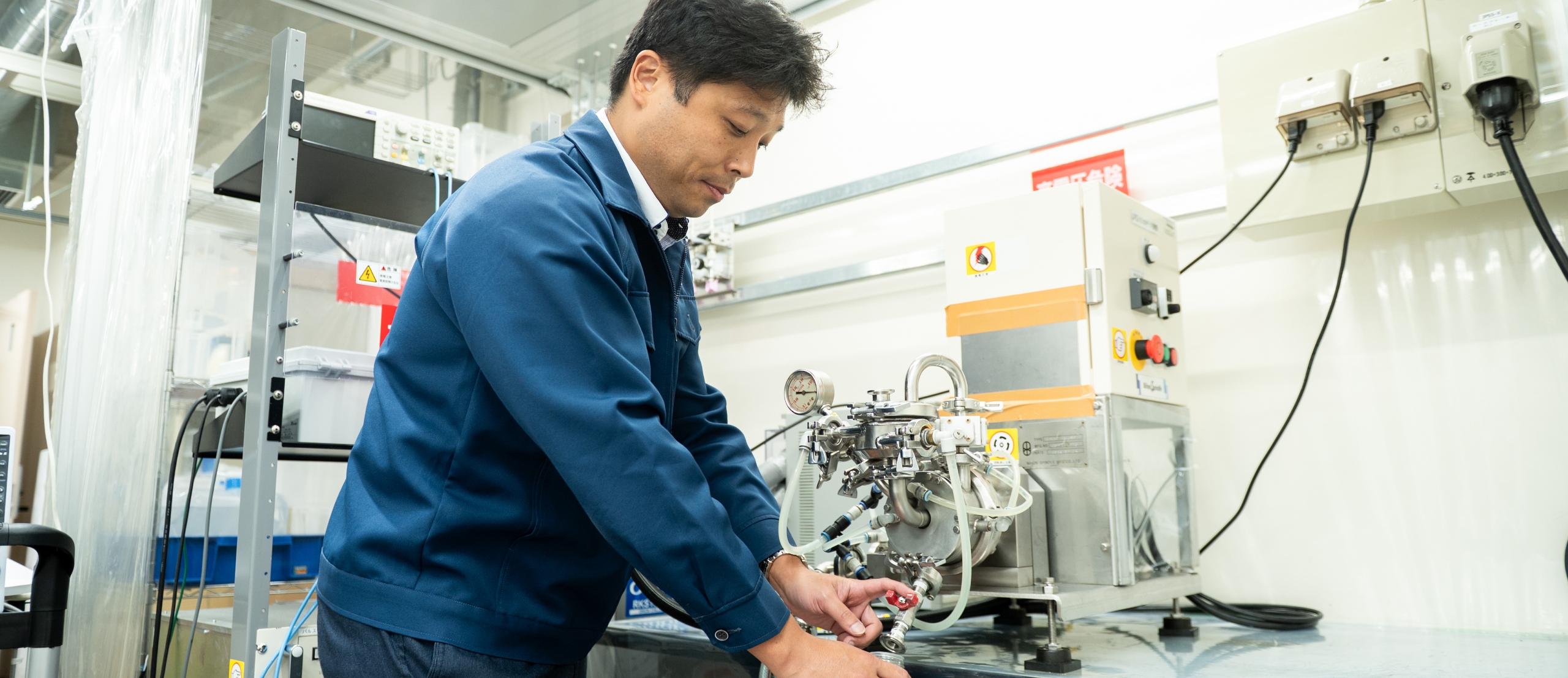
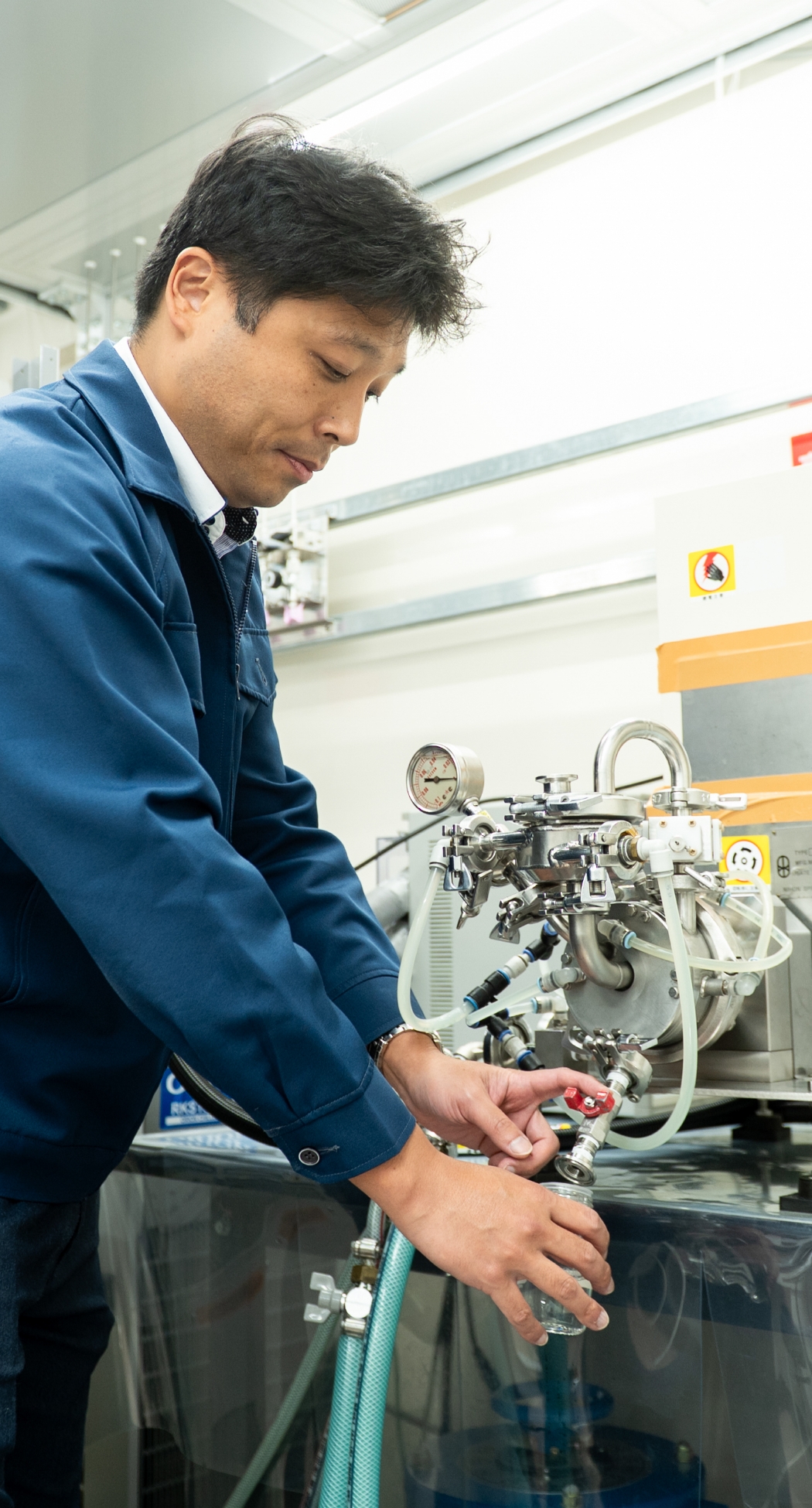
This technology efficiently generates low-temperature plasma by applying high-frequency, high-voltage pulses between electrodes in a liquid containing numerous microbubbles produced by the cavitation phenomenon. During this process, hydrogen peroxide and metal nanoparticles derived from the discharge electrodes are formed, resulting in the production of sterilizing water containing these active components.
The sterilizing water production system is a 10-liter batch-type unit capable of producing approximately 10 liters of sterilizing water per hour. In pest control efficacy tests, it has demonstrated more than 80% control effectiveness, surpassing that of existing environmentally friendly pesticides. Additionally, formulation technologies have been developed to improve adhesion and penetration on crop surfaces.
Regarding safety, high safety has been confirmed through acute oral toxicity tests in rats (LD50 > 5,000 mg/kg) and negative results in genetic mutation assays.
Compared to conventional plasma-in-liquid methods, this technology has already achieved about 100 times greater processing efficiency. Furthermore, automation of the device and optimization of the production process are underway to balance large-scale production with rapid responsiveness in agricultural settings, advancing the development of a sterilizing water production system suitable for commercial-scale use.
The antimicrobial effects of the sterilizing water overcome the short-term decline issues seen in conventional technologies, maintaining efficacy for over five months. Moreover, close collaboration with local organic farmers enables continuous product improvements that reflect field needs.
The sterilizing water is composed of 99.9% water, 0.1% hydrogen peroxide, and trace amounts of metal nanoparticles resulting from electrode wear. Depending on the type of metal nanoparticles, the sterilizing water is classified into two types:
Reactive oxygen species type: Antimicrobial effects mainly due to reactive oxygen species such as hydroxyl radicals (·OH), which gradually decrease but persist for about four weeks.
Metal ion type: Antimicrobial effects primarily attributable to metal ions like silver ions, with efficacy maintained for over five months.
Both types exhibit strong antimicrobial activity while maintaining high safety for humans and the environment.
We plan to complete data accumulation and various tests necessary for obtaining pesticide registration, followed by the prototyping of a continuous-operation system in 2027 and development of a mass-production system by 2029. From 2031 onwards, we aim to launch the product as a full-scale agricultural disinfectant, accelerating its adoption primarily in organic and conventional farming markets.
Furthermore, we are considering expansion into the European market as an alternative to copper-based fungicides, as well as development for use in hot and humid regions such as Southeast Asia.
At the same time, we actively envisage broadening applications in medical, public health, and food sanitation fields, where the technology’s safety and low environmental impact make it a promising sterilization solution across various sectors.
To promote this social implementation, Professor Yoshihiro Oka, CEO of YSH Research Institute Co., Ltd.—a startup originating from the University of Hyogo—has personally founded the company. This structure allows for continuous and efficient advancement of the technology’s practical application and commercialization based on the university’s research seeds.
Moreover, this technology aligns with Japan’s "Green Food System Strategy" target to reduce chemical pesticide risk by 50% and supports the expansion of organic agriculture, representing a socially significant innovation that balances environmental impact reduction with stable food production.
| Research | ||
|---|---|---|
| Journal | Discover Plants | |
| Title | Effect of Discharge Electrode Material on Germination of Radish Sprout using Cavitation Bubble Plasma Treated Water | |
| Author | K. Kawano, S. Nukina, K. Eguchi, T. Okano, N. Shibutani, and Y. Oka | |
| Member | K. Kawano, S. Nukina, K. Eguchi, T. Okano, N. Shibutani, and Y. Oka | |
| URL | https://link.springer.com/article/10.1007/s44372-025-00349-3?utm_source=rct_congratemailt&utm_medium=email&utm_campaign=oa_20250914&utm_content=10.1007%2Fs44372-025-00349-3 | |
| Patent Information | ||
| Patent Number | 7397430 | |
| Application Number | 2022-528862 (PCT/JP2021/020982) | |
| Application Date | June 2, 2021 | |
| Publication Date | December 9, 2021 | |
| Title of the Invention | Liquid for Sterilization and Method for Its Production | |
| Priority Claim Country | Japan, United States, Europe | |
| Applicant | University of Hyogo, Daiichi Manufacturing Co., Ltd. | |
| Inventor | Yoshihiro Oka, Tomohiro Hashimoto | |
| Remarks | Priority Date: June 2, 2020 | |
| Joint and Contract Research Achievements | ||
| Period | From 2014 onwards | |
| Theme | Cavitation plasma technology and cavitation plasma sterilizing water | |
| Partner | Nippon Spindle Manufacturing Co., Ltd., Sumitomo Heavy Industries, Ltd., Dainichi Seisakusho Co., Ltd., Kirin Holdings Company, Limited, Yoshiyama Farm, OHANA Farm, Hyogo Prefectural Industrial Technology Center, Hyogo Prefectural Agriculture, Forestry and Fisheries Technology Center, Osaka Medical and Pharmaceutical University, Fukuchiyama Public University, The Science Tokyo | |
| Budget | From 1 million yen | |
| Information on conferences, exhibitions, and other related events | Conferences ・Annual Meeting of the Institute of Electrical Engineers of Japan (IEEJ) ・Annual IEEJ Section A Conference Exhibitions ・University Fair: Innovation Japan (2016–2018, 2020–2025) ・Matching Inn Himeji (2018, 2022–2025) Events ・3rd Challenge Expo "Towards a Future Society Where Life Shines" (2023) ・Challenge Expo 2024 (2024) ・AgriTech Grand Prix 2023 (2023) ・Co-Creation Innovation at Kyoto Economic Center (2023) ・Kansai Tech Planter Grand Prix (2024) |
|
Learn about the cutting-edge research achievements, advanced technical resources, and know-how that the Graduate School of Engineering at the University of Hyogo can provide. We welcome partners who can create the future together with us by jointly generating new ideas and technologies through collaborative research, commissioned research, and technical consultations.
More