Taking advantage of the unique properties of ionic liquids—non-volatility, non-flammability, and wide electrochemical windows—we design electrolytes for lithium-ion batteries and apply them to the dissolution and chemical modification of natural polymers such as cellulose. Through these approaches, our research aims to create environmentally friendly materials that contribute to a sustainable society from both energy and biomass perspectives.
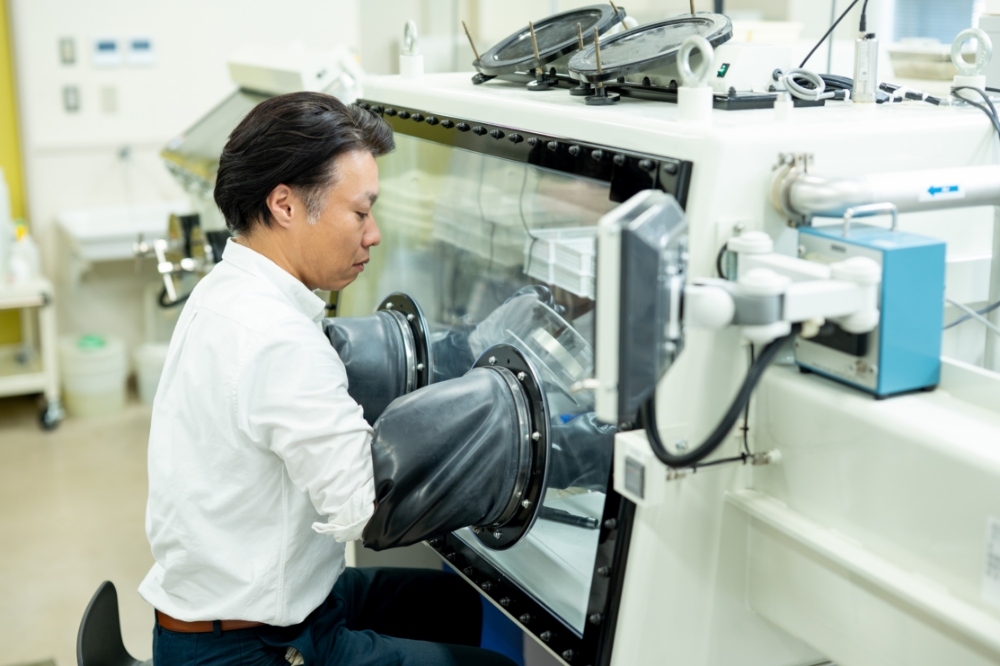
Our research focuses on the development of next-generation energy storage materials and biomass-derived polymers. In particular, we have concentrated on the design of electrolytes for lithium-ion batteries based on ionic liquids. Ionic liquids, with their non-volatility, non-flammability, and wide electrochemical windows, can overcome the limitations of conventional organic solvent-based electrolytes. At the same time, their unique solvation ability enables the dissolution of natural polymers such as cellulose, allowing us to design biomass-derived derivatives and create new functional materials. Through these studies, we aim to develop environmentally friendly materials from both the perspectives of energy storage and biomass utilization, thereby contributing to the realization of a sustainable society.
With the shift away from fossil fuel dependence and the expansion of renewable energy, innovation in energy storage technologies has become an urgent challenge. Although lithium-ion batteries are widely used, further improvements in energy density and safety are required. Conventional organic solvent-based electrolytes suffer from risks such as flammability and instability, underscoring the need for new electrolyte materials. Meanwhile, biomass resources such as cellulose, which are abundant on Earth, have attracted attention as sustainable materials, but their utilization has been limited by their strong hydrogen-bonding network and poor solubility. Ionic liquids, with their high stability and unique solvent capabilities, offer solutions to both challenges simultaneously, making them highly significant as research targets.
Our research proceeds along two main directions. The first is the development of battery electrolytes based on ionic liquids. We design electrolyte systems using various ionic liquids, particularly polymerizable ionic liquids, and investigate their electrochemical properties and interfacial reactions. Special attention is given to the formation, structure, and stability of the solid electrolyte interphase (SEI) on graphite anodes, in order to clarify the relationship between molecular design and battery performance. Furthermore, by combining ionic liquids with oxide solid electrolytes and polymer electrolytes, we are developing novel composite solid electrolytes that achieve both high ionic conductivity and mechanical strength. The second direction focuses on the synthesis of cellulose derivatives. We have established homogeneous dissolution conditions using ionic liquid solvents, and have developed new functional materials through modifications such as allylation, epoxidation, and CO₂-induced cyclic carbonate formation. These efforts represent an interdisciplinary approach that bridges electrochemistry and polymer chemistry.
In the future, our research will expand beyond lithium systems to include sodium and magnesium as next-generation battery electrolytes, with a focus on designing solid electrolytes that combine safety and long cycle life. In parallel, cellulose derivative studies will advance through network structuring and the introduction of ionic functional groups, with an eye toward applications such as electrolyte membranes and separation membranes for energy devices. Through these integrated efforts, we aim to contribute to the practical implementation of environmentally friendly materials in society.

| Research | |
|---|---|
| Journal | Electrochemistry, 90(3), 037006 (5 pages) (2022) |
| Title | Branched alkyl functionalization of imidazolium-based ionic liquids for lithium secondary batteries |
| Author | T. Kakibe*, T. Ohata, R. Honda, S. Matsuda, T. Nakamura and H. Kishi |
| Member | Takeshi Kakibe, Satoshi Matsuda, Tatsuya Nakamura, Hajime Kishi |
| URL | https://www.jstage.jst.go.jp/article/electrochemistry/90/3/90_22-00001/_article |
Learn about the cutting-edge research achievements, advanced technical resources, and know-how that the Graduate School of Engineering at the University of Hyogo can provide. We welcome partners who can create the future together with us by jointly generating new ideas and technologies through collaborative research, commissioned research, and technical consultations.
More