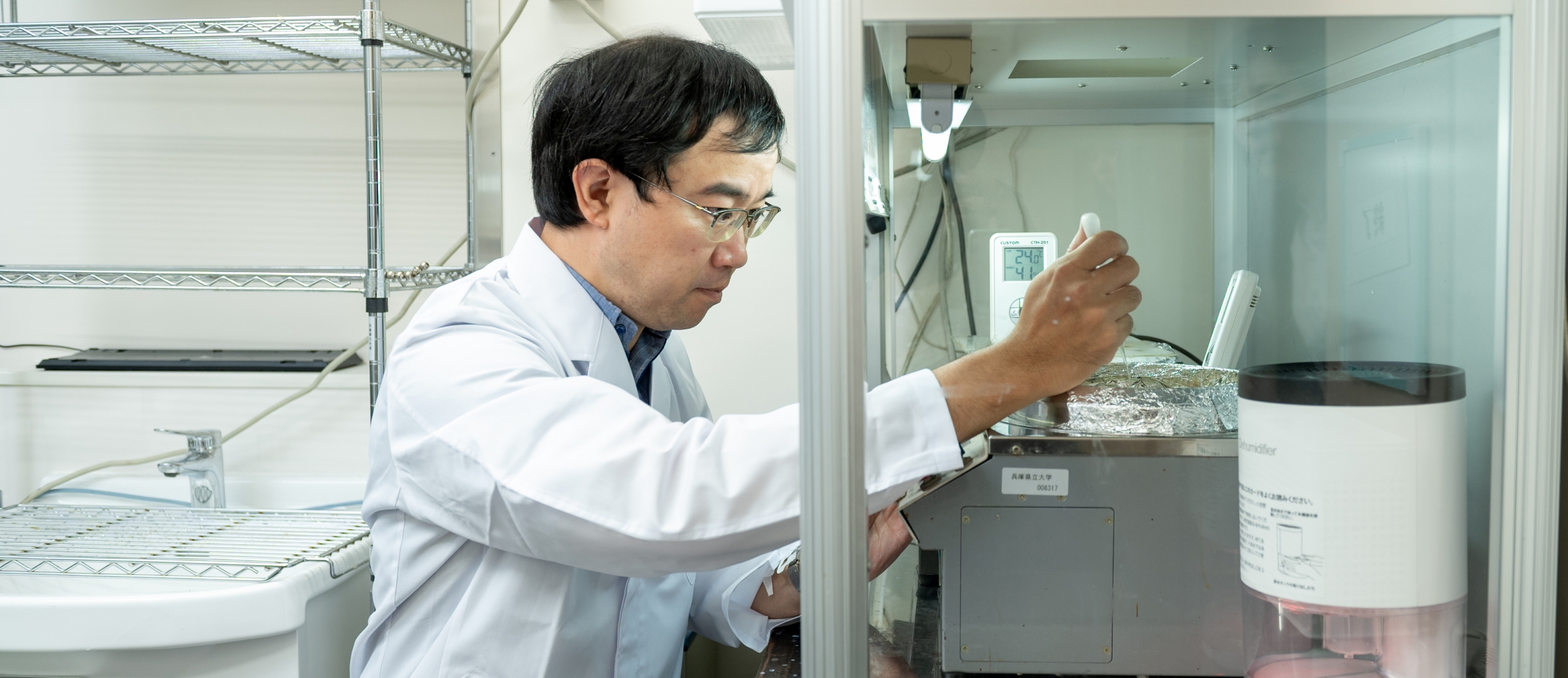
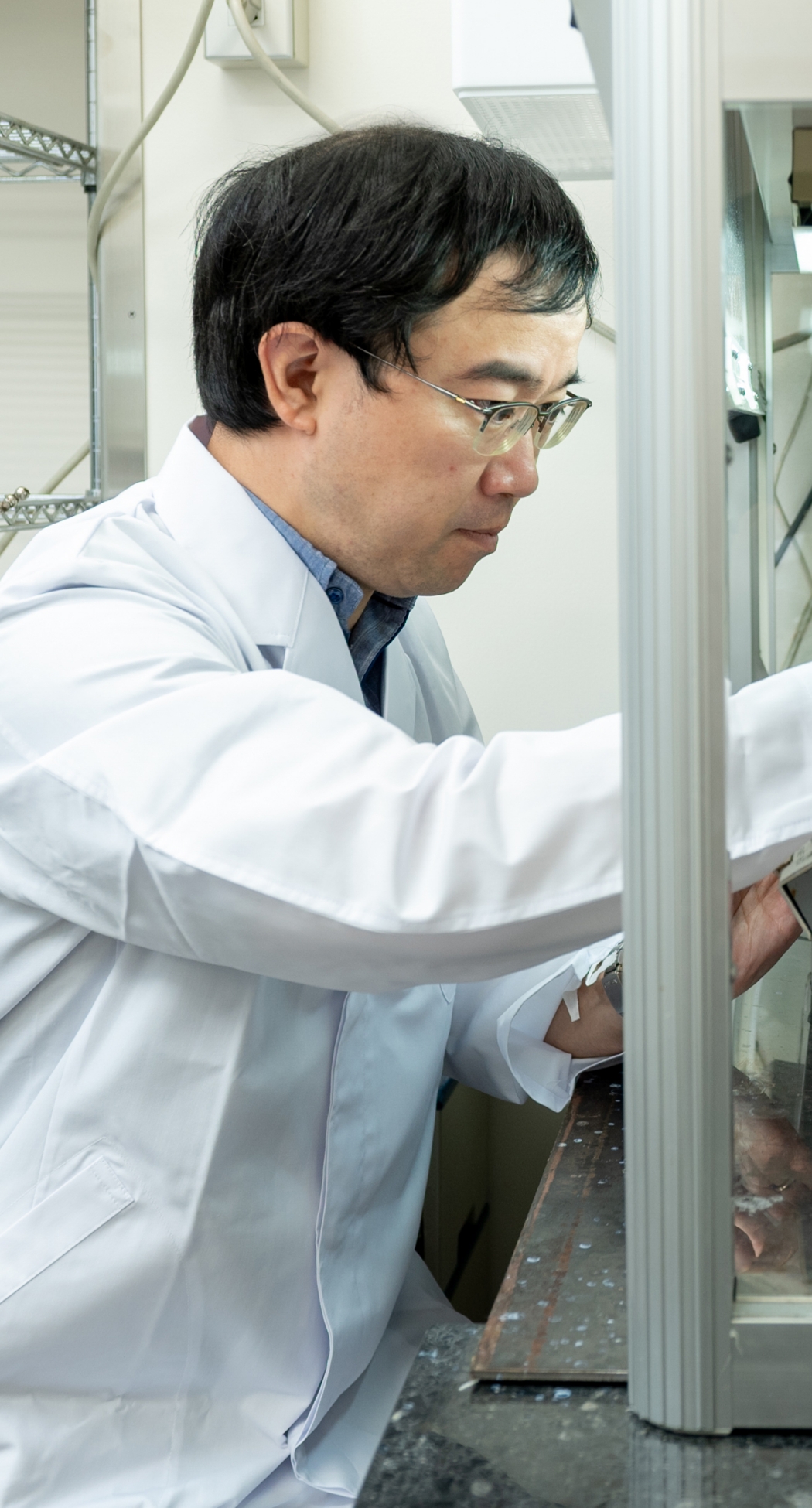
Liquid crystals possess the property of easily altering their molecular alignment in response to external stimuli, making them widely used in fields such as displays and thermometers. We are advancing the development of new materials that can freely change properties including color, transparency, hardness, and shape by incorporating molecules that change form when exposed to light into liquid crystals.
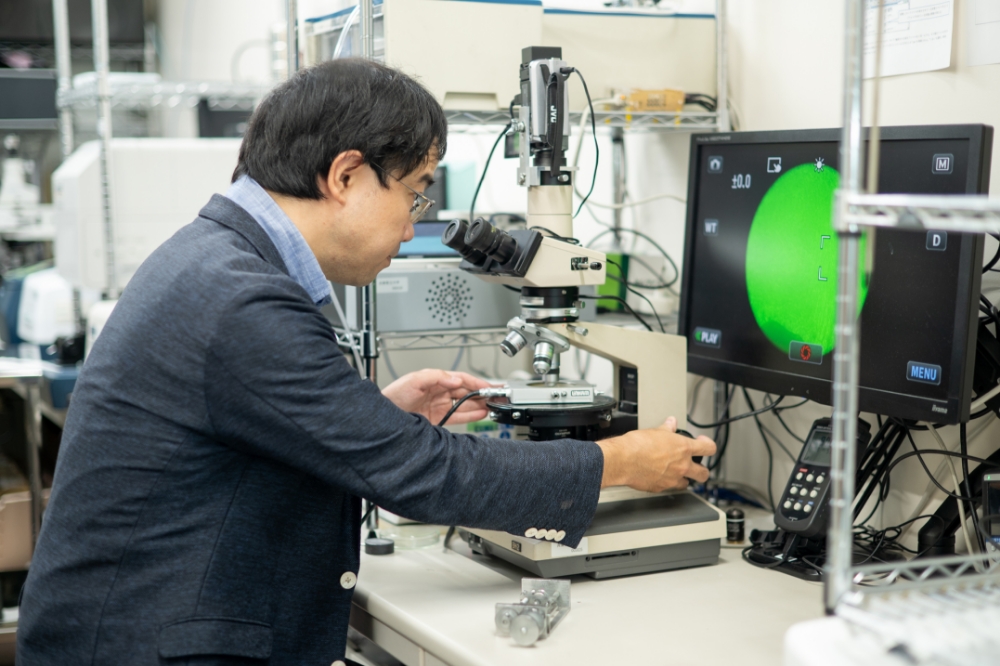
Liquid crystals possess the property of easily altering their molecular alignment in response to external stimuli, making them widely used in various fields such as displays and thermometers. While traditionally controlled by heat or electricity, recent years have seen growing interest in non-contact, environmentally friendly control using light. Specifically, incorporating molecules that change shape in response to light—such as photochromic molecules—into liquid crystal polymers enables changes in color and transparency, as well as adjustments to hardness, adhesion, and even shape, simply by applying light. Utilizing this mechanism is expected to lead to the development of new materials that move or change shape in response to light.
Liquid crystals possess the property of easily altering their molecular alignment in response to external stimuli, making them widely used in various fields such as displays and thermometers. While traditionally controlled by heat or electricity, recent years have seen growing interest in non-contact, environmentally friendly control using light. Specifically, incorporating molecules that change shape in response to light—such as photochromic molecules—into liquid crystal polymers enables changes in color and transparency, as well as adjustments to hardness, adhesion, and even shape, simply by applying light. Utilizing this mechanism is expected to lead to the development of new materials that move or change shape in response to light.
Photochromic dyes such as azobenzene and N-benzylideneaniline possess the property of reversibly changing their molecular shape upon light irradiation. By incorporating these dyes into liquid crystal polymers, it enables control over the local structure of polymer chains and liquid crystallinity through light-induced molecular shape changes. Furthermore, by utilizing linearly polarized light, these changes can be induced directionally, leading to the creation of materials with more advanced functionalities.
Specifically, this is expected to lead to research in the following areas:
・Light-responsive adhesive and tacky materials
・Materials exhibiting anisotropy in hardness and thermal conductivity
・Light-actuated expandable/contractible actuators

| Research | |
|---|---|
| Journal | Chemistry Letters |
| Title | Anisotropic Adhesive Interface Formed by the Spontaneous Orientation Behavior of Liquid Crystal Polymers |
| Author | Mizuho Kondo, Tatsuki Nagata, Yukitaka Hyodo, Daisuke Okai, Hiroki Adachi, Nobuhiro Kawatsuki |
| Member | Mizuho Kondo, Tatsuki Nagata, Yukitaka Hyodo, Daisuke Okai, Hiroki Adachi, Nobuhiro Kawatsuki |
| URL | https://doi.org/10.1093/chemle/upae066 |
Learn about the cutting-edge research achievements, advanced technical resources, and know-how that the Graduate School of Engineering at the University of Hyogo can provide. We welcome partners who can create the future together with us by jointly generating new ideas and technologies through collaborative research, commissioned research, and technical consultations.
More