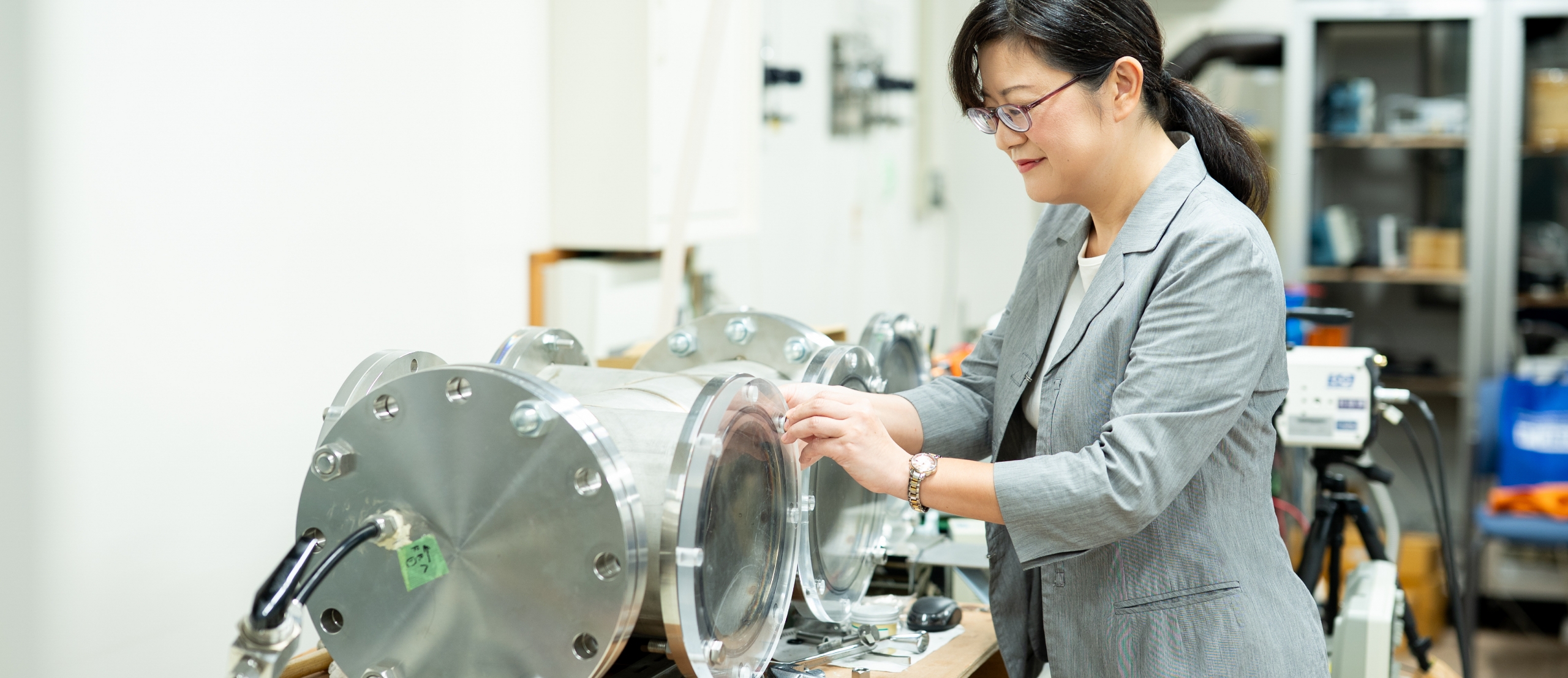

In pursuit of realizing nuclear fusion power—often hailed as the "dream energy source"—I am tackling a wide range of challenges.
Simultaneously, I am applying the academic insights gained through this research to various other fields.

Unlike conventional nuclear power, nuclear fusion does not pose a risk of runaway reactions by its very nature, and its fuel can be extracted from seawater, making it a safe, clean, and sustainable energy source.
Proof-of-concept has been demonstrated—for example, NIF has achieved a fusion energy output 1.5 times greater than the input laser energy.
However, there are still many challenges to overcome before fusion power plants can become operational. I am working to tackle these challenges, while also applying the academic insights gained through this research to other fields.
To initiate a nuclear fusion reaction, it is necessary to heat deuterium and tritium—two isotopes of hydrogen—to an extremely high temperature of over 100 million degrees Celsius. The most critical technology for extracting the immense energy produced in this process is plasma confinement. There are two known methods of confining
plasma: magnetic confinement and inertial confinement. Magnetic confinement involves using powerful magnetic fields generated by electromagnets to confine high-temperature plasma for an extended period of time. Inertial confinement, on the other hand, involves compressing hydrogen fuel by imploded it with extremely powerful lasers, triggering a brief but intense fusion reaction. Although each reaction lasts only a fraction of a second, repeating the process continuously enables sustained fusion power generation.
In both methods, it is necessary to supply fuel to the reactor. I am developing a simple and versatile fueling device based on a multi-stage acceleration system using electromagnetic forces. I am working on elucidating magnetization dynamics, which is essential for the design, by investigating the behavior of magnetic materials under ultra-fast varying magnetic fields through numerical analysis and experiments. In addition, to visualize turbulence—a major issue in fusion plasmas—I am developing a lensless microwave camera. Using machine learning, I have successfully reconstructed high-resolution images that surpass the resolution of the receiving system. These technologies are expected to have applications not only in the field of nuclear fusion, but also in various other areas such as medicine and space.

These researches are expected to contribute to the following areas and technologies:
・Elucidation of magnetization dynamics under ultra-short-time varying magnetic fields
・Hygienic transport of medical instruments and energy-efficient space transport enabled by non-contact systems
・Physical understanding of plasma turbulence through advanced analysis exceeding measurement resolution
・In-vehicle cameras capable of seeing through rain and fog, and medical imaging diagnostics without X-ray exposure

| Research | |
|---|---|
| Journal | Planned Submission |
| Title | Plasma and Fusion Research |
| Author | Development of Target Injection System by Using Electromagnetic Coils |
| Member | Mayuko KOGA, Sotaro UCHINO, Eiki MAEDA |
| URL | Mayuko KOGA |
| Remarks | https://www.jstage.jst.go.jp/article/pfr/18/0/18_2404060/_pdf |
| Joint and Contract Research Achievements | |
| Period | 2024/4/1~2026/3/31 |
| Theme | Research on Attitude Control of Fusion Fuel |
| Partner | EX-Fusion |
Learn about the cutting-edge research achievements, advanced technical resources, and know-how that the Graduate School of Engineering at the University of Hyogo can provide. We welcome partners who can create the future together with us by jointly generating new ideas and technologies through collaborative research, commissioned research, and technical consultations.
More