In processes handling slurries with highly concentrated dispersed fine particles in liquids—such as various battery electrodes, cosmetics, and paints—controlling the dispersion state of particles in the liquid is critically important. Furthermore, efficient particle aggregation technology is required for recovering valuable substances from liquids. This research successfully achieved reversible control of the dispersion state of particles in the liquid through external stimuli like pressure or agitation by optimizing slurry preparation conditions.
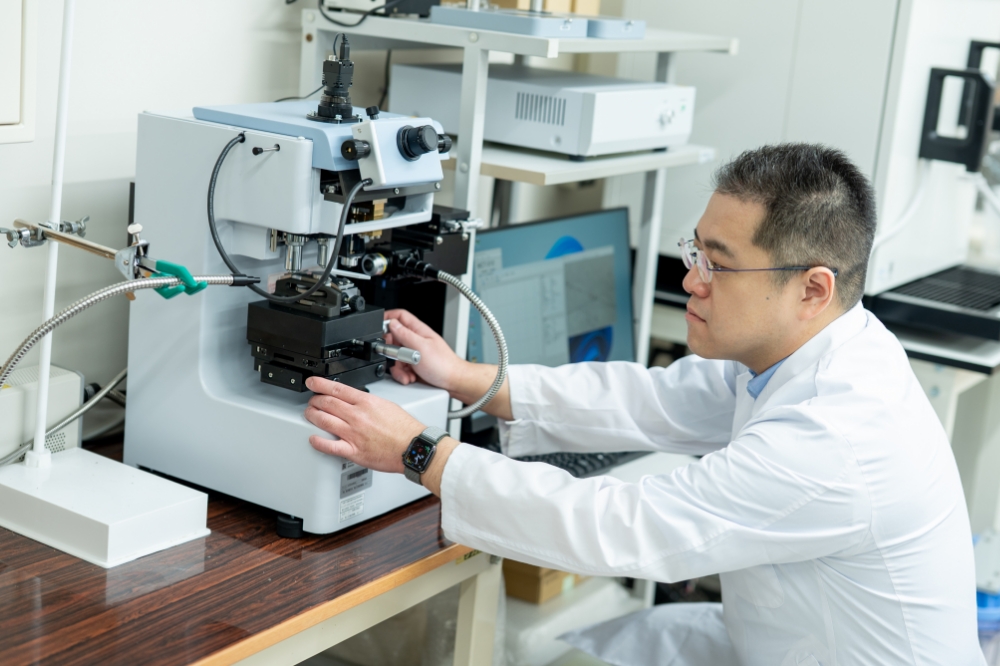
The dispersion state of fine particles in a slurry varies depending on the surface properties of the particles. To reversibly control the dispersion state of fine particles in a slurry through external stimulation, it is necessary to modify the surface of the particles in the liquid to a suitable state. We have investigated the application of particle surface modification using various polymer electrolytes for dispersion state control. Our results show that adding appropriate ions to a slurry prepared with modified particles enables reversible control via agitation. Additionally, using a different modification method allows similar control through external pressure. We believe this approach has broad applicability in various manufacturing processes, water treatment, and valuable material recovery.
Sheet forming of slurries exists in an extremely wide range of fields, including various battery electrodes, electronic components, and cosmetics. Typically, sheets require high packing density and flexibility. Therefore, flexibility is generally imparted by using large amounts of additives, such as binders, in slurries prepared in a well-dispersed state. However, this leads to reduced sheet compactness and generates large amounts of CO₂. Consequently, a significant reduction in additives is required. Furthermore, in water treatment, sedimentation separation utilizing gravity is employed. To enhance operational efficiency, reversible control of the dispersion state of fine particles is required—where particles aggregate during sedimentation and disperse after sedimentation. We addressed these challenges by developing methods to reversibly control the dispersion state of particles in liquid media in response to external stimuli such as agitation or pressure changes.
For agitation-based control, we succeeded by first preparing a well-dispersed slurry using a polymer electrolyte dispersant, then adding an additive (ion) to induce loose flocculation. This principle is identical to the ancient technique of adding nigari (ion) to soy milk to produce tofu. It utilizes the property that the product remains a gel (Tofu) during storage but reverts to a well-dispersed state (soy milk) with gentle agitation during use. We call this a “soft-agglomerated slurry,” which is applicable for manufacturing flexible electronic devices.
The pressure-based method utilizes polymers with pressure-dependent solubility in their side chains, adsorbed onto particles. Changes in surrounding pressure alter the surface state of these particles. This enables reversible dispersion state control via pressure. These particles are termed “pressure-responsive particles” and can be used for recovering valuable substances from liquids.
・Manufacturing of electronic devices such as various battery electrodes and multilayer ceramic capacitors
・Printing and coating technologies using pigment-based inks
・Liquid-type cosmetics
・Water treatment fields such as recovery of valuable materials from liquids

| Research | ||
|---|---|---|
| Journal | Journal of the Society of Powder Technology, Japan | |
| Title | Development of Binder-less Sheet Forming Technology by Controlling the Dispersion State of Slurry | |
| Author | Hiroshi Satone, Kousuke Baba, Kenji Iimura, Shougo Taguchi, Takuji Yamamoto | |
| Member | Hiroshi Satone, Kousuke Baba, Kenji Iimura, Shougo Taguchi, Takuji Yamamoto | |
| URL | https://doi.org/10.4164/sptj.62.357 | |
| Patent Information | ||
| Patent Number | JP6470025B2 | |
| Application Number | JP2014242973A, JP2016104466A | |
| Application Date | 2014/12/1 | |
| Publication Date | 2016/6/9 | |
| Title of the Invention | Recovery method of nanoparticle | |
| Priority Claim Country | Japan | |
| Applicant | University of Hyogo | |
| Inventor | Hiroshi Satone, Kenji Iimura | |
| Joint and Contract Research Achievements | ||
| Period | confidential | |
| Information on conferences, exhibitions, and other related events | Society of Powder Technology, Japan, POWTEX, The Society of Chemical Engineers, Japan, The Society of Separation Process Engineering, Japan, Japan Association of Aerosol Science and Technology, etc... | |
Learn about the cutting-edge research achievements, advanced technical resources, and know-how that the Graduate School of Engineering at the University of Hyogo can provide. We welcome partners who can create the future together with us by jointly generating new ideas and technologies through collaborative research, commissioned research, and technical consultations.
More