
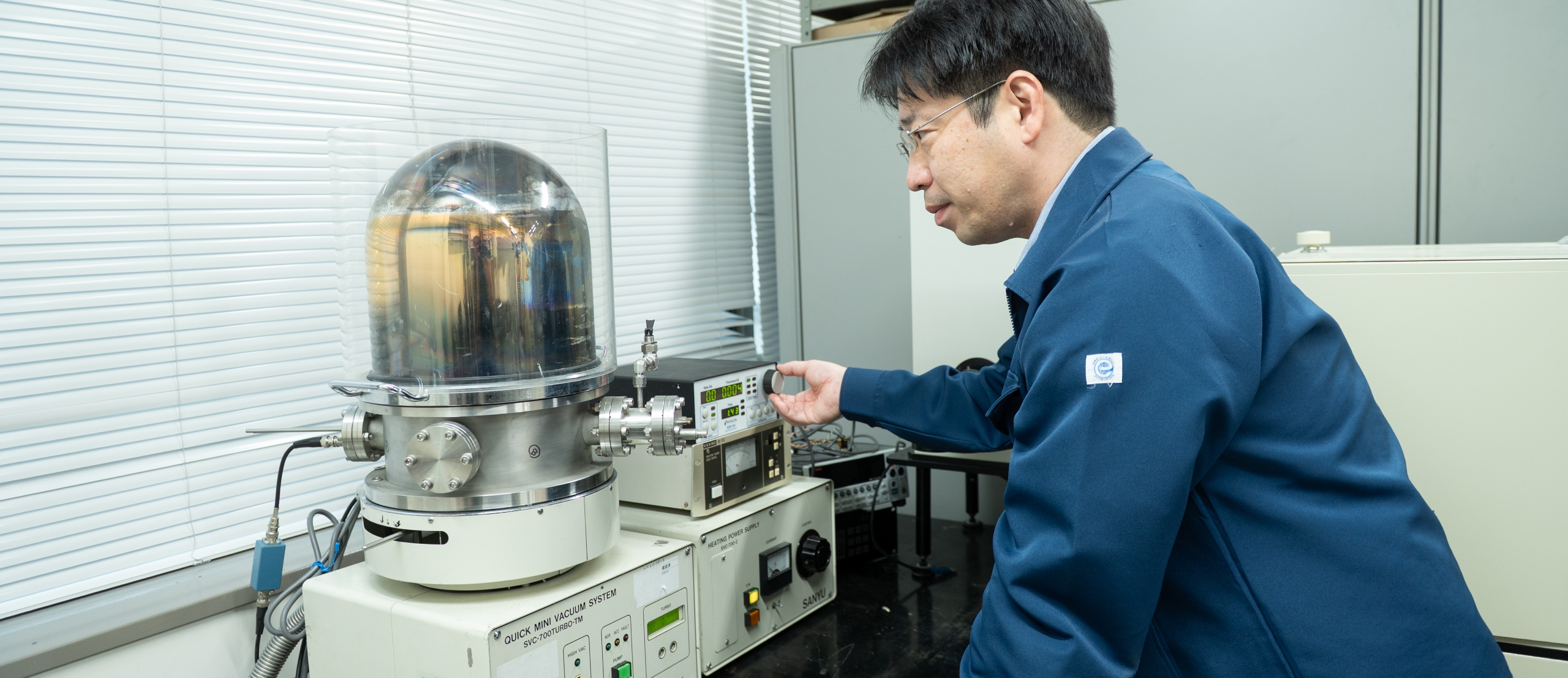

We aim to realize the creation of two-dimensional semiconductor nanosheets with diverse compositions and structures that cannot be achieved with graphene.
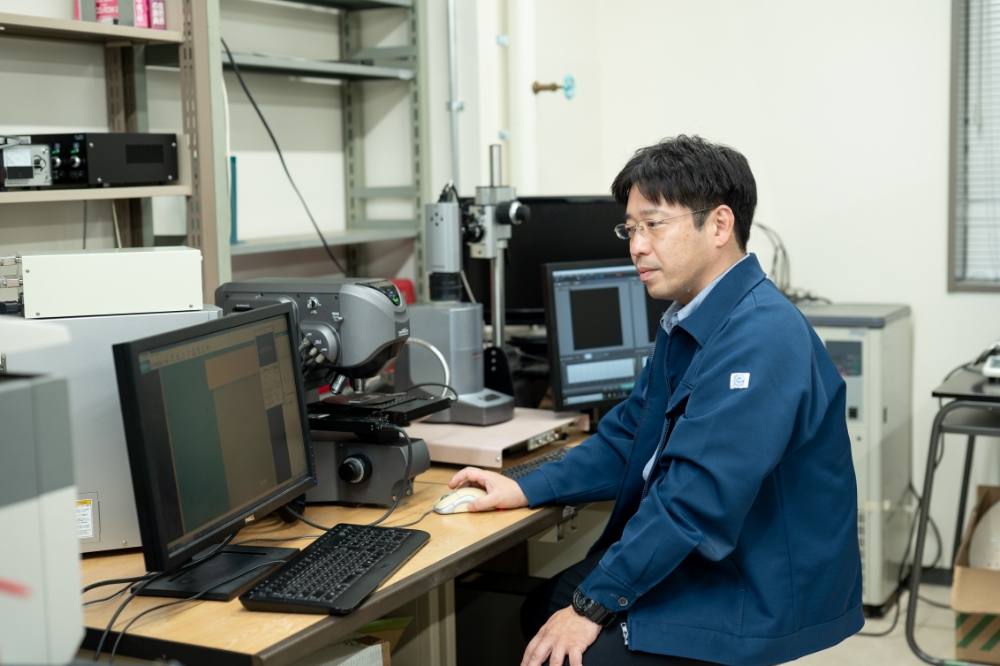
Since the discovery of graphene in 2004, the functional creation and development of two-dimensional nanosheets has progressed rapidly, becoming an important research field in materials science. In this research, we are developing synthesis methods for new two-dimensional semiconductor nanosheets with atomic layer-level thickness using the liquid metal method, a bottom-up synthesis method.
Two-dimensional semiconductor nanosheets with atomic-level thickness exhibit functions different from conventional bulk materials and thin films due to their structural characteristics and are expected to be applied in fields such as electronics and the environment and energy. These nanosheets are mainly produced by exfoliating layered compounds, but conventional methods result in small sizes ranging from a few hundred nanometers to a few micrometers, making them unsuitable for mass production or practical use. Furthermore, they are not suitable for synthesizing non-layered compounds, limiting the options for materials and functions. To overcome these challenges, bottom-up synthesis methods, which enable the synthesis of a wider variety of materials, are attracting much attention.
Bottom-up synthesis allows for flexible design of composition and structure, and it is also possible to synthesize nanosheets of oxides and metals with non-layered compounds. In this study, we focused on one such method, the liquid metal method. This method allows for the exfoliation of large-area two-dimensional oxide films onto the substrate by contacting the oxide film formed on the liquid metal surface with the substrate and utilizing the van der Waals forces generated between the substrate and the oxide film. In this study, we succeeded in synthesizing large-area two-dimensional metal oxide nanosheets of SnO by directly transferring ultrathin stannous oxide (SnO) formed on the surface of liquid tin metal to the substrate. We confirmed that atomically thin two-dimensional SnO nanosheets exhibit semiconducting properties not found in graphene. We also found that photocurrent was generated when irradiated with ultraviolet light, indicating potential applications in photoelectric conversion devices such as optical sensors.
This research holds promise for the development of high-performance pn junction optical sensors using stacked two-dimensional metal oxide nanosheets, and perovskite solar cells using two-dimensional metal oxide nanosheets as carrier transport layers.

| Research | |
|---|---|
| Journal | Extended Abstracts of the 2025 Int. Conf. on Solid State Devices and Materials (2025) |
| Title | Liquid–metal-based Synthesis of SnO Nanosheets and Application to Transparent Ultraviolet Photodetectors |
| Author | Shunjiro Fujii, Haruya Hibi, Naoki Fukumuro |
| URL | https://ssdm.jp/ |
| Journal | Key Engineering Materials 73, 978 (2024) |
| Title | Fabrication of Liquid-Metal Printed 2D Tin Oxide Nanosheets for Optoelectronic Applications |
| Author | Shunjiro Fujii |
| URL | https://www.scientific.net/KEM.978.73 |
Learn about the cutting-edge research achievements, advanced technical resources, and know-how that the Graduate School of Engineering at the University of Hyogo can provide. We welcome partners who can create the future together with us by jointly generating new ideas and technologies through collaborative research, commissioned research, and technical consultations.
More