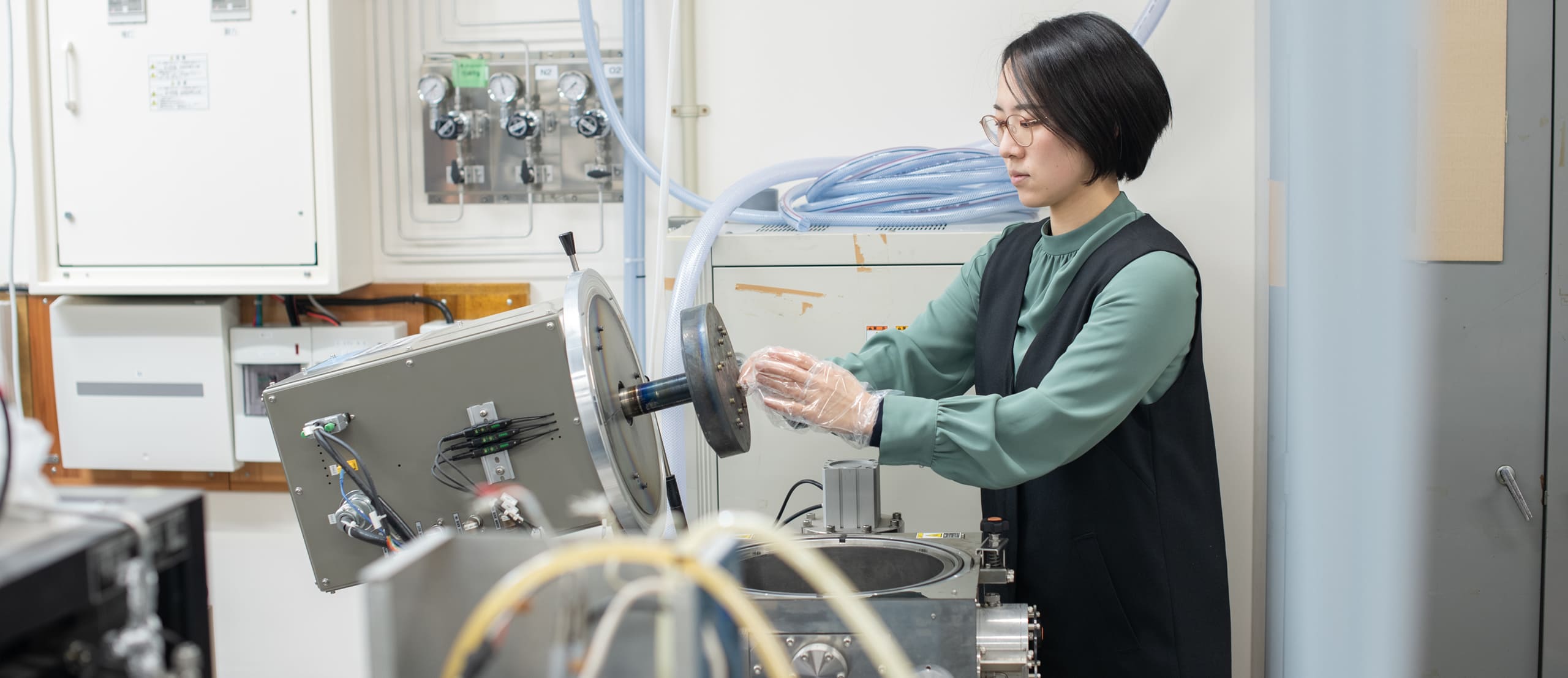

It is well known that thin-film properties are strongly influenced by the surface state of the underlying substrate. However, there have been relatively few studies in which thin-film properties were controlled through the deliberate manipulation of substrate surface states, such as atomic periodicity and cleanliness. In this study, we extend ultraprecision processing techniques—originally developed for X-ray mirror fabrication—to the control of thin-film properties, and investigate property modulation achieved through such processing.
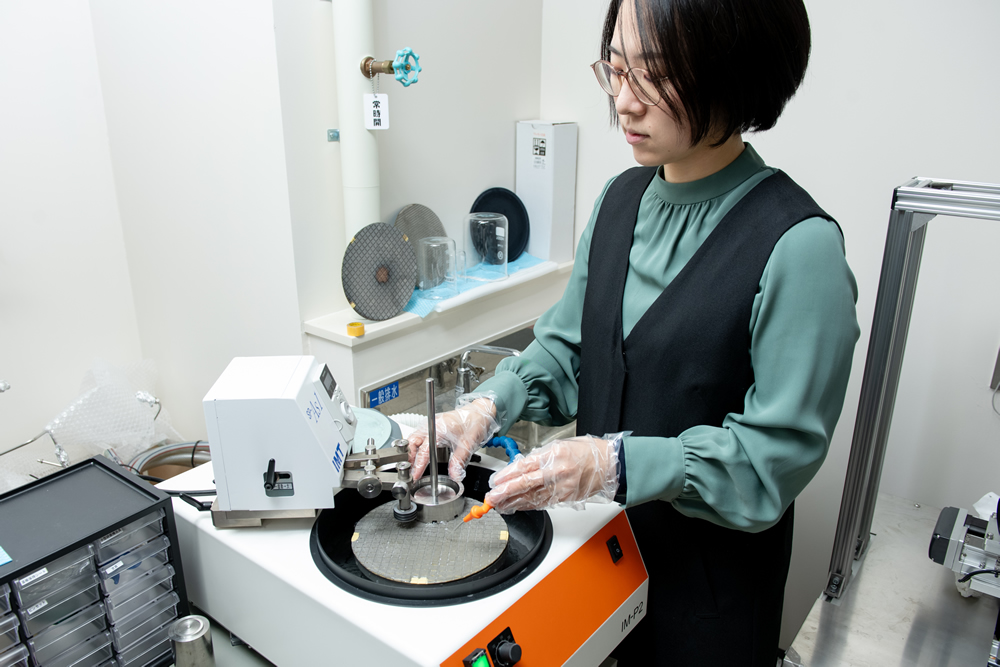
By employing a novel chemical polishing method capable of smoothing material surfaces at the atomic scale, we fabricated an ideal crystal surface free from micro roughness and crystallographic disorder. This ideal surface suppressed degradation caused by unintended structural disorder and allowed the Fe₃O₄ thin films to fully exhibit their intrinsic properties.
With the increasing power consumption in the information and communication sector, semiconductor electronics based on conventional silicon CMOS technology are approaching the limits. To address this challenge and realize new device concepts—so-called Beyond CMOS—there has been vigorous pursuit of novel materials, including functional oxides exhibiting ferromagnetism and ferroelectricity. Transition-metal oxides are an attractive class of materials exhibiting properties such as ferromagnetic semiconductivity and giant ferroelectricity, making them promising candidates for next-generation non-volatile memory. However, realizing their intrinsic properties at the nanoscale has remained a significant challenge.
Fe₃O₄ is a promising spintronic material, exhibiting outstanding properties such as a colossal change in resistivity by more than two orders of magnitude associated with the insulator–metal (Verwey) transition, and nearly 100% spin polarization at room temperature. However, when fabricated at the nanoscale required for devices, its material properties are drastically suppressed. The primary cause is stacking defects arising from atomic-scale disorder, which have hindered both the understanding and the control of Fe₃O₄’s material properties.In this study, we fabricated substrates on which surface roughness and atomic-scale disorder were virtually completely eliminated using a novel chemical polishing method. On this substrate, 50-nm-thick Fe₃O₄ thin films were grown, in which a clear Verwey transition was observed. Similar results were observed in nearly all of the multiple samples fabricated on the substrate, corroborating that a perfectly crystalline surface was realized across the entire substrate. Taken together, these results demonstrate that precise control of substrate surface holds promise not only for advancing the fundamental understanding of thin-film properties but also for improving yield in device applications.
Specifically, these endeavors are anticipated to contribute to research in the following areas:
*The development of miniaturized, high-sensitivity sensors
*The development of high-speed switching devices
*The development of novel devices driven by protons as carriers

| Research | |
|---|---|
| Journal | ASC Appl. Nano Mater. |
| Title | Nondeteriorating Verwey Transition in 50 nm Thick Fe3O4 Films by Virtue of Atomically Flattened MgO Substrates: Implications for Magnetoresistive devices |
| Author | A. I. Osaka, D. Toh, K. Yamauchi, K. Hattori, X. Shi, F. Guo, H. Tanaka, and A. N. Hattori |
| Member | Ai Osaka(Engineering、Electronics and Computer Science) |
| URL | https://pubs.acs.org/doi/10.1021/acsanm.1c02634 |
Learn about the cutting-edge research achievements, advanced technical resources, and know-how that the Graduate School of Engineering at the University of Hyogo can provide. We welcome partners who can create the future together with us by jointly generating new ideas and technologies through collaborative research, commissioned research, and technical consultations.
More