Tomokazu Umeyama
Professor | Ph.D. in Engineering
Applied Chemistry Course
Field of Applied Chemistry
Professor Tomokazu Umeyama strives to make chemistry approachable in his lectures by connecting it to everyday objects and phenomena, and in his laboratory courses he lets students see and touch chemistry—the only discipline capable of creating molecules—for themselves. In his research, while placing great value on understanding fundamental phenomena, he works daily to develop materials that can help resolve the world's energy challenges through the power of chemistry.
Developing Materials for Organic Thin-Film Solar Cells
What students can learn
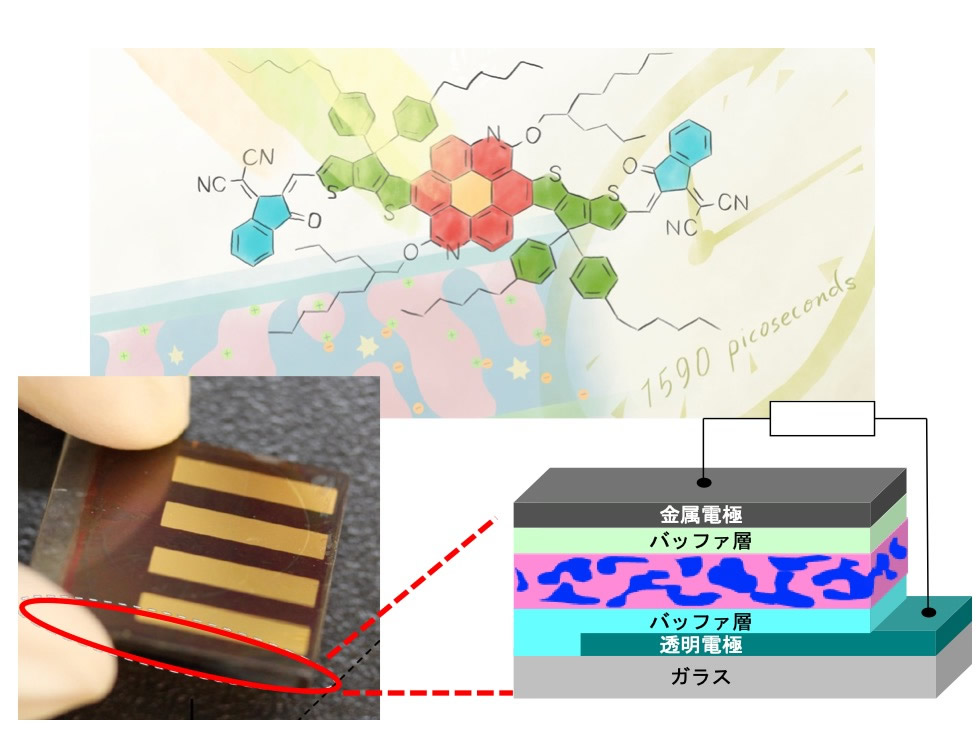
Students acquire the essential organic synthesis know-how of a chemist: designing new molecules, synthesizing them, purifying the products, and confirming their structures. They also develop the skills to assemble devices using the molecules they have created and to evaluate their performance.
This research addresses organic thin-film solar cells, a technology anticipated to serve as a next-generation energy source. Specifically, it involves creating new conjugated molecules for use in the photoactive layer that converts light into electricity. Because they are built from organic compounds, organic thin-film solar cells offer a range of advantages unavailable to conventional silicon solar cells, advantages that can contribute to a sustainable society. They can also be made transparent, lightweight, and flexible, and are expected to give rise to entirely new industries.
Photofunctionalization of Nanostructured Materials
What students can learn
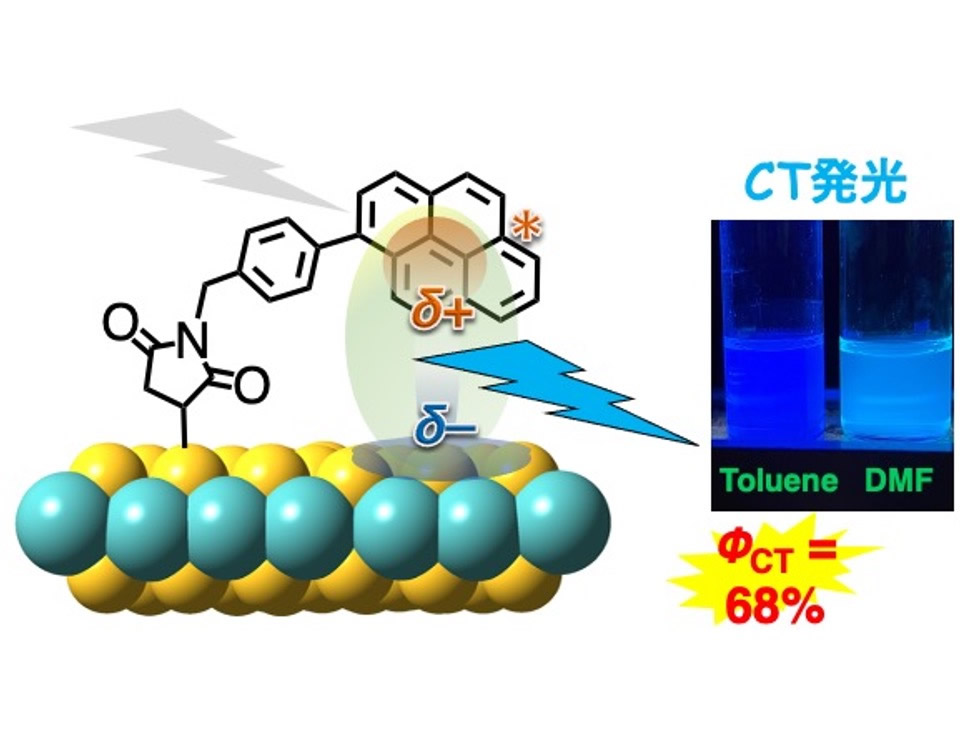
In addition to organic synthesis techniques, students learn solid-phase reaction methods suited to nanostructured materials, as well as structural characterization approaches such as photoelectron spectroscopy and electron microscopy. Through collaborative research, they also develop skills in evaluating optical properties, including laser-based time-resolved spectroscopy.
Nanostructured materials such as single-walled carbon nanotubes, graphene, and transition-metal dichalcogenides are fundamental building blocks of nanotechnology that exhibit intriguing properties in their own right. This research seeks to functionalize these materials more extensively and precisely by combining them with organic molecules. In particular, it draws on organic synthesis expertise to covalently link photofunctional conjugated molecules to nanostructured materials. By harnessing the synergistic effects that arise from this combination, the work aims to apply these hybrid materials to photoenergy conversion devices.