Wataru Suzuki
Assistant Professor | Ph.D. in Science
Applied Chemistry Course
Field of Applied Chemistry
In laboratory courses, the aim is to design content that connects what students have learned in lectures with what they encounter through hands-on experimentation. In research, while placing strong emphasis on a firm grasp of fundamental chemistry, the work cultivates logical reasoning grounded in experimental observation, with the broader goal of developing materials that can contribute to solving energy-related challenges.
Development of Surface Functionalization Methods for Nanomaterials
What students can learn
Students build skills in organic and inorganic synthesis, encompassing the synthesis of inorganic nanomaterials, the design of organic molecules used to modify their surfaces, and methods for integrating the two. They also gain experience with a range of spectroscopic measurement techniques, including X-ray absorption spectroscopy, and with the analytical methods used to characterize the structure and function of the resulting materials.
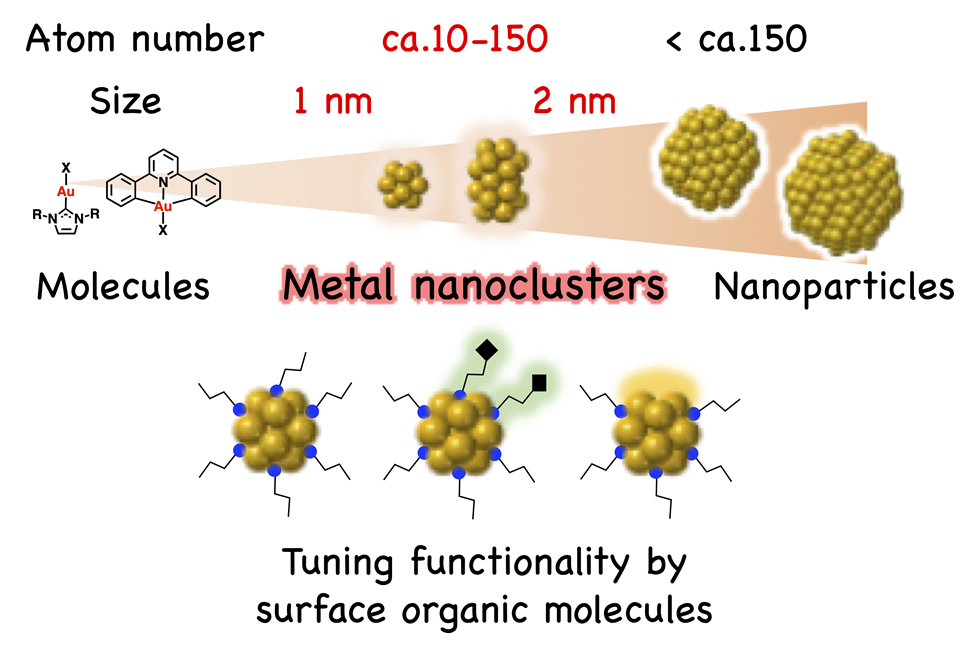
This research develops methods for functionalizing nanometer-scale materials known as metal clusters with organic molecules. Metal clusters exhibit properties intermediate between those of nanoparticles and metal complexes, making them compelling nanomaterials with distinctive catalytic activity and optical properties; combining them with surface organic molecules further enables new functionality through synergistic effects. Drawing on principles of organic chemistry, this work develops methods for arranging custom-designed functional organic molecules on metal nanomaterials with precision, exploring optical properties and reactivity that inorganic nanomaterials alone cannot achieve.